
Australia’s rates of relationship breakdown and re-partnering mean that blended family structures — where one or both partners bring children from a prior relationship into a new household — are now a common feature of Australian life. Estate planning in a blended family is one of the most complex and emotionally charged challenges in succession law.
The interests of a new partner and the interests of children from an earlier relationship can be in direct tension, and a poorly considered estate plan can devastate family relationships that survive the grief of bereavement.
The Danger of ‘All to Spouse’ in a Second Relationship
The default estate plan — leaving everything to the surviving spouse or partner — is straightforward for a first marriage with shared children. In a blended family, it is a recipe for conflict. If you leave your entire estate to your new partner, your children from the first relationship have no guaranteed entitlement. Your new partner may leave your estate to their own children, to a subsequent partner, or may simply spend it down — and your children may receive nothing.
Conversely, leaving your estate directly to your children from the first relationship may leave your new partner without adequate provision, potentially exposing your estate to a family provision application under the Succession Act 2023 (SA). Either approach, taken in isolation, is likely to produce an inequitable outcome for someone.
In a blended family, the question is not simply ‘who do I love?’ — it is ‘how do I protect all of the people I love from each other, and from the unexpected?’
Life Interests — A Partial Solution
One traditional approach to blended family succession is the life interest: the Will gives the surviving partner a right to use or occupy the family home during their lifetime, with the capital passing to the deceased’s children on the surviving partner’s death. Life interests have the advantage of simplicity, but they create a structural tension between the partner’s need for security and the children’s desire to preserve capital. Disputes are common, expensive, and bitter.
Mutual Wills — Promises That Bind Beyond Death
Mutual Wills are an arrangement under which both partners agree to make Wills in particular terms and not to change those Wills without the other’s consent. When one partner dies, equity prevents the survivor from departing from the agreed terms. Mutual Wills can provide certainty for the first generation of children, but they impose significant inflexibility and require meticulous drafting.
Testamentary Discretionary Trusts — The Modern Solution
For most blended families, the most flexible and effective solution is a well-drafted testamentary discretionary trust. Under this structure, assets pass into trust on the first death, with a trustee holding assets for the benefit of a class that includes both the surviving partner and the children from the first relationship. The trustee has discretion to distribute income and capital among the beneficiaries in proportions that reflect their needs from year to year.
The surviving partner receives adequate support during their lifetime; the children of the first relationship receive their share on the survivor’s death or earlier at the trustee’s discretion. A carefully drafted trust deed can include provisions protecting capital for the first-generation children while allowing genuine flexibility.
Key Advantage: A testamentary discretionary trust with an independent trustee removes the structural conflict between a surviving partner and children from a prior relationship.
Family Provision Claims in Blended Families
Under the Succession Act 2023 (SA), a spouse, former spouse, domestic partner, child, or stepchild of the deceased may be eligible to make a family provision application if they have not been adequately provided for. In a blended family, both the surviving partner and children from the first relationship may have standing to claim. An estate plan that carefully balances the interests of all family members is the most reliable prophylactic against contested proceedings.
The Position of Stepchildren
Stepchildren — children of your partner who are not your biological or adopted children — have no automatic entitlement on your intestacy and may have limited standing to bring a family provision application depending on the nature of your relationship. If you wish to provide for stepchildren, you must do so expressly in your Will.
Conclusion
Blended family estate planning requires more thought, more documentation, and more professional input than a simple ‘all to spouse’ arrangement. The investment is worthwhile — a well-structured plan can preserve family harmony and protect the interests of everyone you care about.
Want to Find Out More?
If you would like further advice about estate planning for blended families, second marriages, or protecting the interests of children from a prior relationship, contact our friendly team.
When it comes to Wills, Probate, Deceased Estates, asset protection and estate planning in Australia, you can trust the oldest law firm in South Australia – Genders & Partners – to guide you through the tough decisions you must make for your family’s future care and welfare.
If you have any questions or would like further information, or a quick phone call to discuss, book a timeslot for a free 15-minute phone consultation.
We can help you to protect yourself and your family. We look forward to being of service.
More Blended Family Estate Planning Resources
- FAQs
- Videos – Wills and Estate Planning
- Articles about Wills and Estate Planning
- Articles about Testamentary Trusts
- Articles about Family Provision and Contested Estates
All these and many more blended family and estate planning topics are available for discussion with the oldest law firm in South Australia. Visit our articles page to explore our complete library of estate planning resources.
DISCLAIMER: This article is intended as general information only and does not constitute legal advice. The law relating to estate planning for blended families is complex and the circumstances of each family differ significantly. You should obtain specific legal advice from a qualified practitioner before taking or refraining from any action. Genders and Partners accepts no liability for reliance on this article without such advice.
5 Common Dangers in Using DIY Kits
To access this infographic click Here
Rod Genders is a senior Australian lawyer specialising in trusts, Wills and estate planning, accident compensation, and probate and deceased estate administration in Adelaide and all over South Australia. His boutique specialist law firm, which was founded on 1848, is one of the oldest and most respected in Australia. Rod is also a prolific author and speaker. Some of his articles and books on Wills, Probate, Trusts, Estate Planning, Asset Protection and Retirement Planning may be found at www.genders.com.au.
Enjoy this article? Check out the full report containing “A Guide for Beneficiaries of a Deceased Estate in South Australia” from senior Australian lawyer Rod Genders.
FREE REPORT “Deceased Estates Simplified”
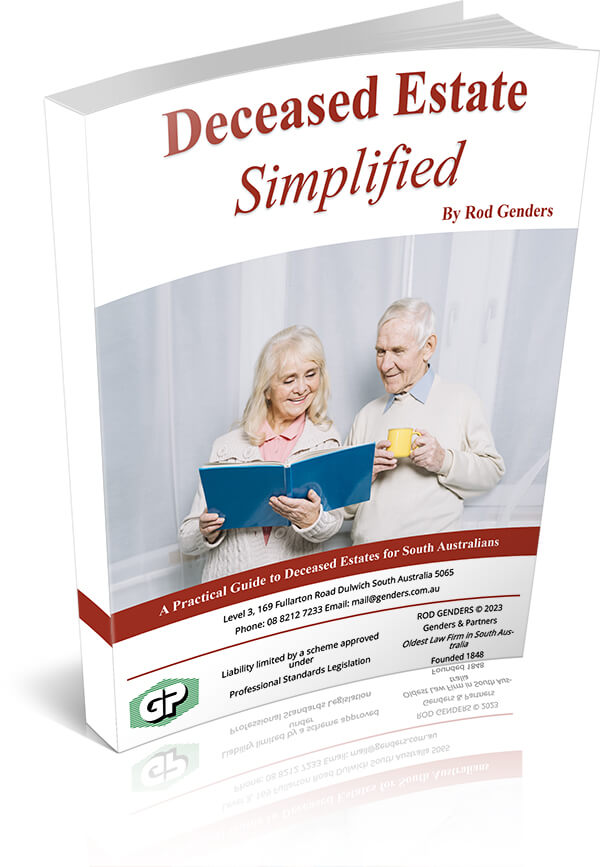
In this report you will learn:
- A simple, easy to understand explanation of the estate settlement process so you anticipate what’s to come and can plan your next steps.
- Detailed information on your duties and responsibilities as an Executor, Administrator or Personal Legal Representative of an estate.
- How to handle delicate situations with beneficiaries and dependents and what you can do to resolve conflict.
- What you need to do if the deceased did not have a will
- How to deal with personal effects, property, and taxes.