
For many Australians, superannuation is the largest single asset they will accumulate over a working lifetime. Yet despite its size, superannuation is also one of the most misunderstood assets from an estate planning perspective. The critical point — one that surprises many clients — is that your superannuation does not automatically pass according to your Will.
Superannuation Sits Outside Your Estate
Your superannuation balance is held in trust by the trustee of your superannuation fund. When you die, the trustee exercises a discretion to pay your death benefit to one or more of your eligible dependants or to your estate. Your Will governs your estate — it does not govern your superannuation.
This means that a Will carefully drafted to distribute your assets in a particular way has no direct effect on your superannuation balance. If the fund trustee exercises its discretion in a way you did not intend — perhaps paying your benefit to a former partner, an estranged child, or distributing it in proportions you would not have chosen — your family has very limited recourse.
Your superannuation is not governed by your Will. Without a valid binding death benefit nomination, the fund trustee decides who receives your superannuation balance.
Binding vs Non-Binding Nominations
Most superannuation funds allow you to make a death benefit nomination. There are two principal types.
A non-binding nomination expresses your preference but does not bind the trustee. The trustee will take your nomination into account but is not required to follow it. If your circumstances have changed — a separation, a new relationship, the birth of a child — and your nomination is out of date, the trustee must exercise its discretion based on the current facts.
A binding death benefit nomination directs the trustee to pay your benefit to the person or persons you nominate, in the proportions you specify. Provided the nomination is validly made and current, the trustee must comply. A binding nomination removes the uncertainty of trustee discretion.
The Three-Year Lapsing Trap
Most binding death benefit nominations lapse automatically after three years from the date they were made — unless your fund provides for a non-lapsing binding nomination. A lapsed binding nomination reverts to a non-binding preference, returning discretion to the trustee.
An alarming number of Australians make a binding nomination, file it, and promptly forget about it. Three years later it lapses, silently. The first time the family discovers the nomination has lapsed is when they are dealing with the fund trustee after a death — and by then, it is too late.
Action: Check your binding death benefit nomination right now. When was it made? Has it lapsed? Does it still reflect your current intentions?
Who Can You Nominate?
A binding death benefit nomination can only be made in favour of eligible persons — generally: your spouse or de facto partner; your children (of any age); any other person who is financially dependent on you; any person with whom you are in an interdependency relationship; or your legal personal representative (your estate). The rules vary between funds.
Nominating your estate allows your death benefit to flow into your estate and be dealt with under your Will — potentially through a testamentary discretionary trust — giving your executor control over the timing and manner of distribution. This approach may have tax implications and specialist financial planning advice should be obtained.
Self-Managed Superannuation Funds
Self-Managed Superannuation Funds (SMSFs) present additional complexity. The SMSF trust deed governs how death benefits are paid and whether binding nominations are recognised. In many SMSFs, the remaining member-trustee or director of the corporate trustee has significant control over the payment of death benefits. Estate planning for SMSF members requires careful attention to the trust deed, the trustee structure, and the interaction between the SMSF and the broader estate plan.
Integrating Superannuation with Your Estate Plan
The interaction between your superannuation, your Will, your testamentary trust, and your family’s tax position requires coordinated advice from both an estate planning lawyer and a financial planner. In particular, the tax treatment of superannuation death benefits depends on whether the recipient is a tax-dependent or a non-tax-dependent. Superannuation paid to a non-tax-dependent such as an adult child may attract significant tax, which should be factored into the planning.
Conclusion
Your superannuation death benefit nomination is one of the most consequential estate planning decisions you will make. Review it now, review it every three years, and review it after every major life event. Ensure it is coordinated with your Will and the rest of your estate plan. If it has lapsed, renew it today.
Want to Find Out More?
If you would like further advice about superannuation death benefit nominations, or how to integrate your superannuation with your estate plan, contact our friendly team.
When it comes to Wills, Probate, Deceased Estates, asset protection and estate planning in Australia, you can trust the oldest law firm in South Australia – Genders & Partners – to guide you through the tough decisions you must make for your family’s future care and welfare.
If you have any questions or would like further information, or a quick phone call to discuss, book a timeslot for a free 15-minute phone consultation.
We can help you to protect yourself and your family. We look forward to being of service.
More Superannuation and Estate Planning Resources
- FAQs
- Videos – Superannuation and Estate Planning
- Articles about Superannuation and Deceased Estates
- Articles about Testamentary Trusts
- Articles about Wills and Estate Planning
All these and many more superannuation and estate planning topics are available for discussion with the oldest law firm in South Australia. Visit our articles page to explore our complete library of estate planning resources.
DISCLAIMER: This article is intended as general information only and does not constitute legal or financial advice. Superannuation law and taxation are complex and the circumstances of each individual differ significantly. You should obtain specific advice from a qualified legal and financial planning practitioner before taking any action in relation to your superannuation or estate plan. Genders and Partners accepts no liability for reliance on this article without such advice.
5 Common Dangers in Using DIY Kits
To access this infographic click Here
Rod Genders is a senior Australian lawyer specialising in trusts, Wills and estate planning, accident compensation, and probate and deceased estate administration in Adelaide and all over South Australia. His boutique specialist law firm, which was founded on 1848, is one of the oldest and most respected in Australia. Rod is also a prolific author and speaker. Some of his articles and books on Wills, Probate, Trusts, Estate Planning, Asset Protection and Retirement Planning may be found at www.genders.com.au.
Enjoy this article? Check out the full report containing “A Guide for Beneficiaries of a Deceased Estate in South Australia” from senior Australian lawyer Rod Genders.
FREE REPORT “Deceased Estates Simplified”
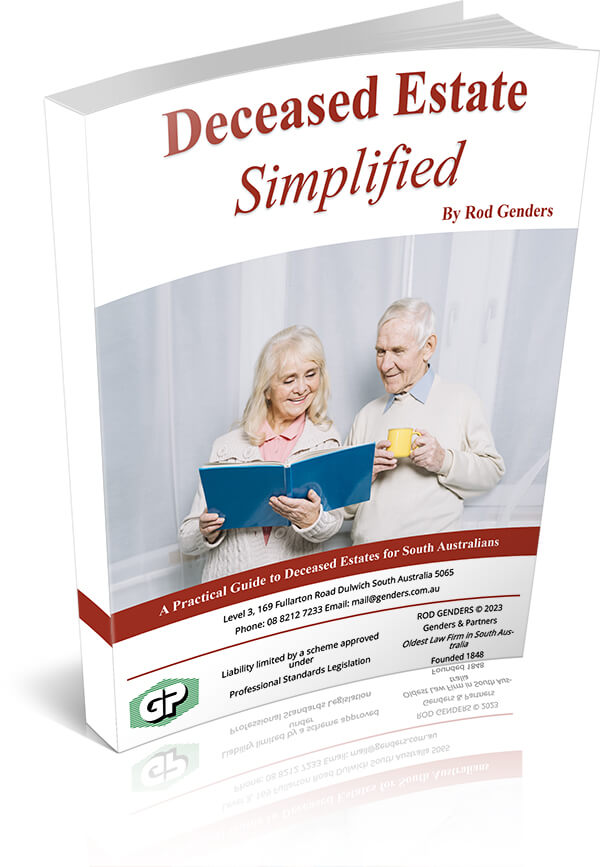
In this report you will learn:
- A simple, easy to understand explanation of the estate settlement process so you anticipate what’s to come and can plan your next steps.
- Detailed information on your duties and responsibilities as an Executor, Administrator or Personal Legal Representative of an estate.
- How to handle delicate situations with beneficiaries and dependents and what you can do to resolve conflict.
- What you need to do if the deceased did not have a will
- How to deal with personal effects, property, and taxes.