
Among the more distressing phenomena encountered in succession law practice is the marriage of convenience — sometimes called a predatory marriage — in which a person cultivates a relationship with an older or cognitively vulnerable individual for the purpose of securing an inheritance. The legal consequences for the victim’s family can be severe, and South Australian law has only recently moved to address them.
What Is Predatory Marriage?
A predatory marriage occurs when one party enters into a marriage primarily to benefit financially from the other’s estate, often targeting a person who is elderly, recently bereaved, socially isolated, or experiencing cognitive decline. The predator may present as a carer, companion, or friend before engineering a marriage that the vulnerable person may not fully understand or freely consent to.
What makes predatory marriage particularly insidious as a legal matter is the interplay between marriage and testamentary instruments. Under the Succession Act 2023 (SA), marriage generally revokes any Will made before the marriage unless the Will was made in contemplation of that specific marriage. A person who marries without updating their Will — or who marries while lacking testamentary capacity — may die leaving an estate distributed on intestacy, in which case the surviving spouse receives a very substantial share.
Marriage revokes a prior Will under the Succession Act 2023 (SA) unless the Will expressly states it was made in contemplation of that marriage. A predatory marriage can therefore entirely displace a carefully prepared estate plan.
The Capacity Question
A valid marriage requires the capacity to consent — that is, the parties must understand the nature of marriage and the effect of the marriage ceremony. This is a lower threshold than testamentary capacity. A person may lack the capacity to make a Will, yet be found to have had sufficient capacity to marry.
This asymmetry is one of the most troubling features of predatory marriage. It means that a person who could not lawfully make a Will — perhaps because dementia had already affected their reasoning — may nonetheless be legally married, with the consequence that their carefully planned estate passes to a predatory spouse rather than to their family.
Challenging a marriage on capacity grounds after the death of the vulnerable party is expensive, uncertain, and emotionally taxing. The evidence required — retrospective assessment of capacity at the time of the ceremony — is often difficult to obtain and contest.
Warning Signs for Families
Families who are concerned about a vulnerable relative should be alert to the following indicators.
- A new relationship that develops rapidly, particularly with a person significantly younger or of markedly different background
- Increasing social isolation of the vulnerable person from established family and friends
- Changes in financial behaviour — new accounts, changed signatories, unexplained withdrawals
- A new Will, Power of Attorney, or financial arrangement made shortly after the new relationship began
- Resistance by the new partner to family involvement in the vulnerable person’s affairs
- Expressions of confusion or distress by the vulnerable person about the relationship
What Can Be Done Preventatively?
The best protection against predatory marriage is a comprehensive, current estate plan prepared while the person is unquestionably competent and surrounded by people who know them well.
A Will made in contemplation of a specific marriage will survive that marriage, preserving the testator’s pre-existing wishes. However, this provision must be explicitly included — it does not arise automatically.
An Enduring Power of Attorney, prepared while capacity is unimpeachable and given to a trusted attorney with appropriate safeguards, can provide a mechanism for monitoring and challenging financial exploitation. An Advance Care Directive under the Advance Care Directives Act 2013 (SA) appoints a trusted substitute decision-maker for health and personal matters.
Key Preventative Steps: Make a current Will; prepare an Enduring Power of Attorney and Advance Care Directive; maintain strong family communication; and review binding superannuation nominations regularly.
The Intersection with Family Provision
Even where a predatory marriage is identified and challenged, the surviving spouse may have standing to bring a family provision application under the Succession Act 2023 (SA). The court must consider all relevant circumstances, including the nature and quality of the relationship, when assessing any claim. Families who believe a marriage was predatory should obtain legal advice promptly, as time limits apply.
Conclusion
Predatory marriage remains an underreported and under-remedied form of elder financial abuse. South Australian succession law has not yet fully closed the gap between the capacity required to marry and the capacity required to make a Will. In this environment, prevention is overwhelmingly preferable to cure. A proactive, well-documented estate plan, reviewed regularly and prepared in consultation with a specialist succession lawyer, is the most reliable protection available.
Want to Find Out More?
If you would like further advice about elder law, predatory marriage, or protecting a vulnerable family member from financial abuse, contact our friendly team.
When it comes to Wills, Probate, Deceased Estates, asset protection and estate planning in Australia, you can trust the oldest law firm in South Australia – Genders & Partners – to guide you through the tough decisions you must make for your family’s future care and welfare.
If you have any questions or would like further information, or a quick phone call to discuss, book a timeslot for a free 15-minute phone consultation.
We can help you to protect yourself and your family. We look forward to being of service.
More Elder Law and Financial Abuse Resources
- FAQs
- Videos – Elder Law and Financial Abuse
- Articles about Elder Law and Financial Abuse
- Articles about Enduring Powers of Attorney
- Articles about Wills and Estate Planning
All these and many more elder law and financial abuse topics are available for discussion with the oldest law firm in South Australia. Visit our articles page to explore our complete library of estate planning resources.
DISCLAIMER: This article is intended as general information only and does not constitute legal advice. The law relating to elder abuse, capacity, and predatory marriage is complex and the circumstances of each individual differ. You should obtain specific legal advice from a qualified practitioner before taking or refraining from any action. Genders and Partners accepts no liability for reliance on this article without such advice.
5 Common Dangers in Using DIY Kits
To access this infographic click Here
Rod Genders is a senior Australian lawyer specialising in trusts, Wills and estate planning, accident compensation, and probate and deceased estate administration in Adelaide and all over South Australia. His boutique specialist law firm, which was founded on 1848, is one of the oldest and most respected in Australia. Rod is also a prolific author and speaker. Some of his articles and books on Wills, Probate, Trusts, Estate Planning, Asset Protection and Retirement Planning may be found at www.genders.com.au.
Enjoy this article? Check out the full report containing “A Guide for Beneficiaries of a Deceased Estate in South Australia” from senior Australian lawyer Rod Genders.
FREE REPORT “Deceased Estates Simplified”
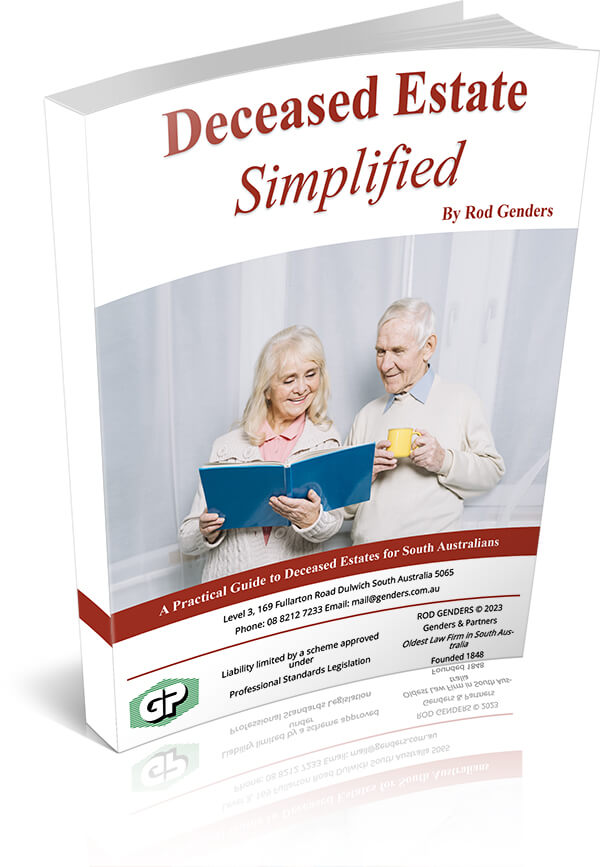
In this report you will learn:
- A simple, easy to understand explanation of the estate settlement process so you anticipate what’s to come and can plan your next steps.
- Detailed information on your duties and responsibilities as an Executor, Administrator or Personal Legal Representative of an estate.
- How to handle delicate situations with beneficiaries and dependents and what you can do to resolve conflict.
- What you need to do if the deceased did not have a will
- How to deal with personal effects, property, and taxes.