Why homemade Wills consistently create exactly the problems they were designed to prevent
The Judicial Verdict on DIY Wills
In 2014, Western Australian Supreme Court Master Craig Sanderson delivered a judgment that passed rapidly into the folklore of Australian succession law. Homemade Wills, Master Sanderson observed, are “a curse”. They arrive in court “invariably”, he said, and they create disputes and litigation that consume the very assets the testator spent a lifetime accumulating.
In the decade since that judgment, the volume of estate litigation driven by defective DIY and homemade Wills has, if anything, increased.
The cruel irony of a DIY Will is this: the testator made it in the sincere belief that they were saving their family money and inconvenience. In many cases, they have done precisely the opposite.
What the Law Requires: Formal Validity Under the Succession Act 2023 (SA)
In South Australia, the formal requirements for a valid Will are now contained in the Succession Act 2023 (SA), which commenced on 1 January 2025, replacing the former Wills Act 1936 (SA). Section 8 of the Act sets out the requirements:
- The Will must be in writing
- It must be signed by the testator (or by some other person in the testator’s presence and at the testator’s direction)
- The signature must be made or acknowledged by the testator in the presence of at least two witnesses present at the same time
- Each witness must sign the Will in the presence of the testator
Strict compliance with each of these requirements is essential. A failure in any one of them renders the Will formally invalid. The consequences of formal invalidity are severe: the testator is treated as having died intestate.
The Informal Will Saving Provision
The Succession Act 2023 (SA) contains a curative provision at section 8(4), which empowers the Court to admit a document to probate as an informal Will if the Court is satisfied the document was intended by the deceased to be their Will. However, such an application requires legal representation, affidavit evidence, and costs that can amount to tens of thousands of dollars. It is a safety net, not a substitute for professional drafting.
The Most Common DIY Will Errors
1. Improper Witnessing
Under the Succession Act 2023 (SA), a Will must be witnessed by two persons present at the same time. A witness must not be a beneficiary under the Will, or the spouse or domestic partner of a beneficiary. Where a witness is also a beneficiary, the gift to that person may be void.
2. Failure to Revoke Prior Wills
A Will should contain an express revocation clause: a clear statement that all prior Wills and codicils are revoked. Many DIY Wills omit this clause, or include it in a form that is legally ambiguous.
3. Ambiguous or Contradictory Gifts
Language that is perfectly clear to the testator may be deeply ambiguous to a court. “I leave my house to my children equally”: which house? Which children? What happens if the house is sold before the testator dies? A specialist Will drafter anticipates these questions and provides express answers.
4. No Provision for Substitute Beneficiaries
What happens if a beneficiary predeceases the testator? Under section 53 of the Succession Act 2023 (SA), a gift to a child or remoter issue of the testator who predeceases does not automatically lapse if the child or remoter issue leaves issue who survive the testator. However, this provision does not apply to all beneficiaries.
5. Superannuation and Life Insurance
Superannuation and most life insurance death benefits do not form part of the estate and are not controlled by the Will. Many DIY Will makers do not understand this, and their superannuation binding death benefit nominations may have lapsed, leaving the fund trustee to decide distribution at their discretion.
The Family Provision Dimension
Even a perfectly valid, professionally drafted Will can be challenged under the family provision jurisdiction of the Succession Act 2023 (SA). A defective Will is dramatically more vulnerable to challenge because its meaning may be ambiguous, and a testator who drafted their own Will without professional advice is less likely to have documented their reasons for unequal provision.
The Succession Act 2023 (SA) requires the Court to give maximum weight to the testator’s expressed wishes. A Will prepared with professional advice, accompanied by clear explanatory correspondence, provides far better protection against a family provision claim than a DIY document whose ambiguities invite challenge.
The True Cost of a DIY Will
A professionally drafted Will from an experienced succession lawyer in Adelaide typically costs a fraction of what a contested estate proceeding will cost. The average cost of contested estate litigation in Australia has been estimated at more than $50,000 per party.
A Will is not a document you draft for yourself. It is a document you draft for your family. The question is not whether you can afford professional advice. It is whether your family can afford the consequences of doing without it.
Want to Find Out More?
If you would like to have your Will professionally reviewed, or if you are concerned that a homemade Will may not be valid, contact our friendly team.
When it comes to Wills, Probate, Deceased Estates, asset protection and estate planning in Australia, you can trust the oldest law firm in South Australia – Genders & Partners – to guide you through the tough decisions you must make for your family’s future care and welfare.
If you have any questions or would like further information, or a quick phone call to discuss, book a timeslot for a free 15-minute phone consultation.
We can help you to protect yourself and your family. We look forward to being of service.
More Wills and Probate Resources
- FAQs
- Videos – Wills and Probate
- Articles about Wills and Estate Planning
- Articles about Probate and Estate Administration
- Articles about Contested Estates
All these and many more wills and probate topics are available for discussion with the oldest law firm in South Australia. Visit our articles page to explore our complete library of estate planning resources.
5 Common Dangers in Using DIY Kits
To access this infographic click Here
Rod Genders is a senior Australian lawyer specialising in trusts, Wills and estate planning, accident compensation, and probate and deceased estate administration in Adelaide and all over South Australia. His boutique specialist law firm, which was founded on 1848, is one of the oldest and most respected in Australia. Rod is also a prolific author and speaker. Some of his articles and books on Wills, Probate, Trusts, Estate Planning, Asset Protection and Retirement Planning may be found at www.genders.com.au.
Enjoy this article? Check out the full report containing “A Guide for Beneficiaries of a Deceased Estate in South Australia” from senior Australian lawyer Rod Genders.
FREE REPORT “Deceased Estates Simplified”
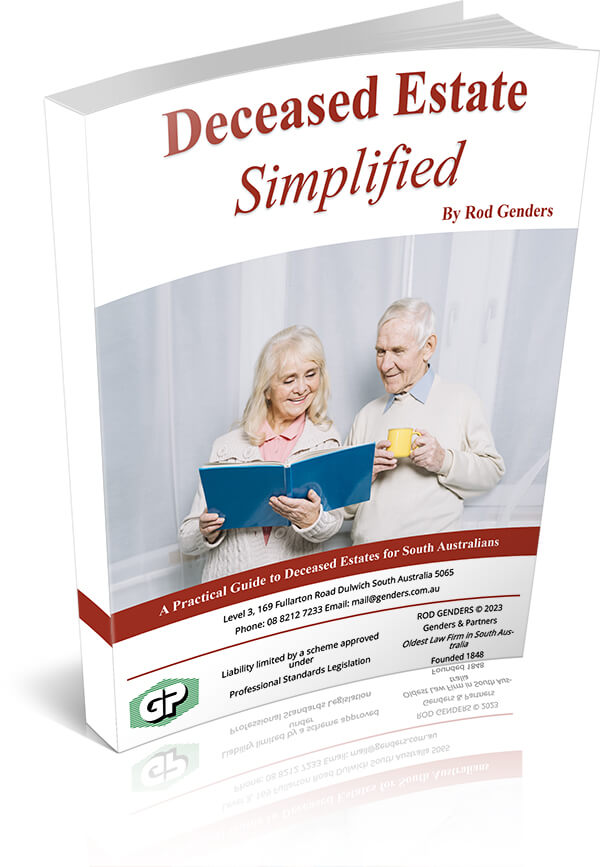
In this report you will learn:
- A simple, easy to understand explanation of the estate settlement process so you anticipate what’s to come and can plan your next steps.
- Detailed information on your duties and responsibilities as an Executor, Administrator or Personal Legal Representative of an estate.
- How to handle delicate situations with beneficiaries and dependents and what you can do to resolve conflict.
- What you need to do if the deceased did not have a will
- How to deal with personal effects, property, and taxes.