How to protect the people you love during Australia’s greatest ever wealth transfer

The Greatest Wealth Transfer in Australian History
Australia is in the midst of the largest intergenerational transfer of wealth ever seen. Economists estimate that Baby Boomers – those born between 1946 and 1964 – will pass on more than $3.5 trillion in assets to the next generation over the coming two decades. This extraordinary transfer will reshape the financial futures of millions of Australian families.
Yet, despite the staggering sums involved, a disturbing number of Australians are approaching this moment entirely unprepared. No Will. No plan. No clear expression of their wishes. The result, in many families, is catastrophe.
Research consistently shows that nearly two thirds of Australian adults do not have a current, valid Will. For Baby Boomers specifically, the stakes of this oversight have never been higher.
What Happens When You Die Without a Valid Will?
Dying without a valid Will is called dying “intestate”. In South Australia, intestacy is now governed by the Succession Act 2023 (SA), which commenced operation on 1 January 2025, replacing the former Administration and Probate Act 1919 (SA) in its entirety.
Under the Succession Act 2023 (SA), if you die intestate, a fixed statutory formula determines who inherits your estate – and that formula may bear no resemblance whatsoever to what you actually wanted.
Who Misses Out Under Intestacy?
Under the statutory intestacy rules, the following people typically receive nothing at all:
- Unmarried partners who cannot establish a qualifying de facto relationship
- Step-children who were not formally adopted
- Long-term friends and carers, no matter how devoted
- Charities, community organisations and religious bodies you supported throughout your life
- Grandchildren (unless their parent has predeceased you)
The government does not know – and does not care – that you raised your step-children as your own, or that your closest companion of thirty years happens not to be your legal spouse. Without a Will, the law decides. And it decides by formula, not by affection.
The DIY Will Trap
Faced with the prospect of dying intestate, many Australians reach for a DIY Will kit from a newsagent or an online template. This is understandable. It is also, in many cases, deeply counterproductive.
Australian courts process thousands of contested estate matters each year, and DIY and homemade Wills consistently account for a disproportionate share of that litigation. The average cost of contesting an estate has been estimated at more than $50,000 – money that comes directly from the very assets you intended to pass on.
“Homemade Wills are a curse.” That was the assessment of Western Australian Supreme Court Master Craig Sanderson in a widely-reported 2014 judgment. Little has changed in the decade since.
The Succession Act 2023 (SA) does give the Court power to admit an informal document as a Will if the Court is satisfied it was intended to be a testamentary document (s 8). However, making an application to the Court costs time, money and anxiety – resources that could easily have been saved by proper professional drafting in the first place.
Common DIY Will Errors That Lead to Court
The following mistakes appear with depressing regularity in contested estate matters:
- Incorrect witnessing – one or both witnesses being a beneficiary or the spouse of a beneficiary
- Failure to properly revoke a prior Will, resulting in two competing documents
- Ambiguous or contradictory language that no longer reflects the testator’s true intentions
- Failure to account for assets acquired after the Will was made
- No provision for substitute beneficiaries if a primary beneficiary dies first
- Failure to consider the interaction of superannuation and life insurance with the estate
Superannuation: The Hidden Landmine
One of the most common – and most expensive – estate planning misconceptions is the assumption that superannuation forms part of the estate and passes in accordance with the Will. In most cases, it does not.
Superannuation death benefits are paid by the trustee of the fund at the trustee’s discretion, having regard to any binding death benefit nomination (BDBN) on file. If your BDBN has lapsed, the trustee decides where your superannuation goes.
A properly integrated estate plan treats superannuation, life insurance, investment accounts, real property, business interests and the Will as a coordinated whole – not as separate, unrelated documents.
Family Provision Claims Under the Succession Act 2023 (SA)
Even the most carefully drafted Will can be challenged. The Succession Act 2023 (SA) preserves – and in some respects expands – the right of eligible persons to apply to the Court for further provision from a deceased estate if they have not been adequately provided for.
The Act requires the Court to give maximum weight to the testator’s expressed wishes when considering whether to make an order for further provision. A properly drafted Will, with clear written reasons where gifts may appear unequal, provides the testator with considerably greater protection than a DIY document.
What Does a Proper Estate Plan Look Like?
A sound estate plan for a Baby Boomer in 2026 typically includes the following elements:
- A professionally drafted Will that is clear, unambiguous and reflective of current circumstances and intentions
- An Enduring Power of Attorney appointing a trusted person to manage your financial and legal affairs if you lose capacity
- An Advance Care Directive (under the Advance Care Directives Act 2013 (SA)) setting out your preferences for medical treatment and personal care
- Current, non-lapsed binding death benefit nominations for all superannuation funds
- Consideration of whether a testamentary trust structure would benefit your beneficiaries
- A family succession plan if you own a farm or a business
- Regular review – at minimum every three years, or after any major life event
Why Regular Review is Non-Negotiable
The commencement of the Succession Act 2023 (SA) on 1 January 2025 is itself a reason to review any existing estate planning documents prepared under the old legislative framework. The new legislation introduces important changes to intestacy rules, family provision rights and the formal requirements for Wills.
The Cost of Not Planning
The emotional and financial cost of dying without a proper estate plan falls almost entirely on the people you leave behind. Families that might otherwise have been united by grief find themselves divided by disputes. Legal costs consume assets intended for beneficiaries.
You have spent a lifetime building your assets. A comprehensive estate plan ensures those assets reach the people you intend, in the manner you choose, with the minimum possible cost, conflict and delay.
Want to Find Out More?
If you would like further advice about estate planning, Wills, or protecting your family’s inheritance during Australia’s greatest ever wealth transfer, contact our friendly team.
When it comes to Wills, Probate, Deceased Estates, asset protection and estate planning in Australia, you can trust the oldest law firm in South Australia – Genders & Partners – to guide you through the tough decisions you must make for your family’s future care and welfare.
If you have any questions or would like further information, or a quick phone call to discuss, book a timeslot for a free 15-minute phone consultation.
We can help you to protect yourself and your family. We look forward to being of service.
More Estate Planning Resources
- FAQs
- Videos – Wills & Estate Planning
- Articles about Wills and Estate Planning
- Articles about Superannuation and Deceased Estates
- Articles about Testamentary Trusts
All these and many more estate planning topics are available for discussion with the oldest law firm in South Australia. Visit our articles page to explore our complete library of estate planning resources.
.
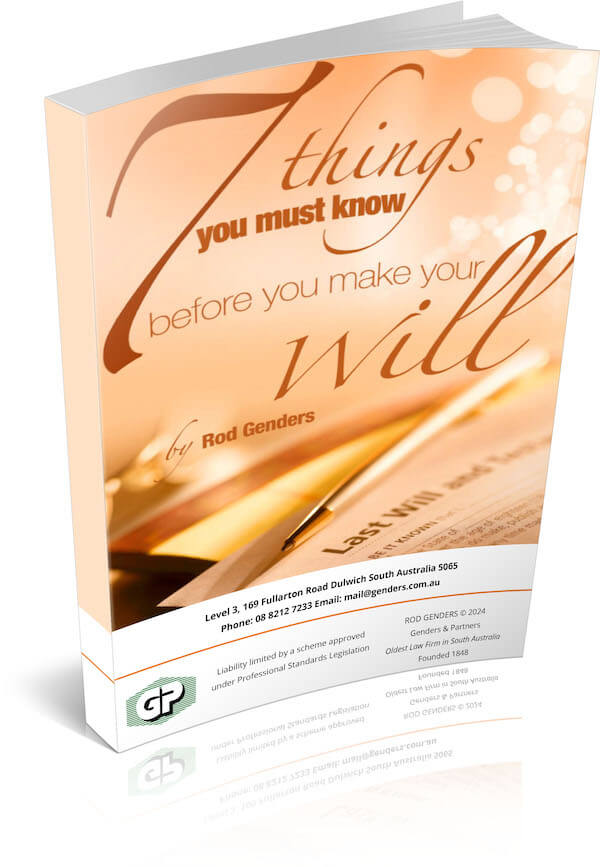
SPECIAL REPORT “7 Things You Must Know Before You Make Your Will”
In this report you will Learn:
Why home-made Wills can be a LOT more expensive than you might think.
The secret weapons used by the rich & powerful to protect their assets, and transfer their wealth two or three generations ahead.
How Estate and Trustee Companies make BIG money from “free” Wills.
The Most Common Estate Planning Mistakes, how they can cost your family a fortune, and How to Avoid Them.
The Elements of a Sound Estate Plan – why a Will alone is not enough.
How to Make Sure Your Assets Stay in Your Family and are not lost to creditors, lawsuits or ex-spouses.
How to guard against challenges to your Estate after you’re gone.