
Approximately half of all Australian adults do not have a Will. For some, this reflects a deliberate (if misguided) choice; for most, it is simply the result of procrastination — of assuming there is plenty of time, that it will not matter, or that the law will sort things out. In practice, dying without a Will — a state known as dying ‘intestate’ — can have significant and sometimes distressing consequences for the people left behind.
This article explains what happens to your estate if you die without a Will in South Australia, how the intestacy rules work, who benefits and who may be left out, and why making a proper Will is almost always the better alternative.
The Legal Framework: The Succession Act 2023 (SA)
In South Australia, the rules governing what happens when a person dies intestate are found in the Succession Act 2023 (SA). The Act sets out a statutory order of priority for the distribution of an intestate estate — in other words, the law decides who gets what, entirely irrespective of what the deceased may have intended or what family members might expect.
It is worth pausing on that point. When you die without a Will, the law does not attempt to work out what you would have wanted. It applies a fixed formula, designed for an idealised family structure that may bear little resemblance to your own. The results can be surprising, and not always in a welcome way.
The Intestacy Distribution Rules
Under the Succession Act 2023 (SA), the intestate estate is distributed broadly as follows. These rules apply only to assets that form part of the deceased’s estate — jointly owned assets, superannuation, and assets held in trust are dealt with separately.
Spouse or domestic partner alone (no children): The spouse or domestic partner takes the whole estate.
Spouse or domestic partner plus children of the relationship: The spouse or domestic partner takes the whole estate.
Spouse or domestic partner plus children who are not children of the relationship (ie. children from a previous relationship): The spouse or domestic partner takes the household chattels, a statutory legacy (a fixed dollar amount adjusted periodically), and one half of the balance. The remaining half is divided equally among the deceased’s children.
Children only (no surviving spouse or domestic partner): The estate is divided equally among the children. If a child has predeceased the testator and left issue (their own children), the deceased child’s share passes to their issue.
No spouse, domestic partner, or children: The estate passes to other relatives in a prescribed order: parents first, then siblings, then grandparents, then aunts and uncles, and so on. If no relatives at all can be identified, the estate passes to the State.
The intestacy rules in the Succession Act 2023 (SA) are designed for a standard nuclear family. They may produce results that are entirely at odds with the wishes of someone with a blended family, an estranged spouse, a long-term de facto partner, or adult children from multiple relationships.
Who May Miss Out Under Intestacy?
The intestacy rules recognise only certain legal relationships. A number of people who might reasonably expect to benefit from an estate may receive nothing at all:
- Stepchildren: A stepchild has no automatic entitlement under the intestacy rules unless they have been formally adopted. A beloved stepchild with whom the deceased had a parent-child relationship for decades may receive nothing.
- Long-term partners who are not legally recognised: The definition of ‘domestic partner’ under the Act requires that the couple lived together on a genuine domestic basis. A partner who does not meet this definition may have no entitlement, regardless of the length or nature of the relationship.
- Friends, carers, and other close associates: No matter how important a friend or carer was to the deceased, they have no entitlement under the intestacy rules.
- Charities and other organisations: Any charitable or community organisation that the deceased wished to benefit receives nothing under intestacy.
- Estranged relatives: Conversely, an estranged child, parent, or sibling with whom the deceased had no meaningful relationship may be entitled to a share of the estate under the intestacy rules, even if the deceased would have strongly objected.
Blended Families: A Particular Vulnerability
The interaction between the intestacy rules and blended family structures can produce profoundly unfair results. Consider the situation of a person who has remarried after a first marriage, has children from the first marriage, and has built a life with their second spouse. Under the intestacy rules, their second spouse takes a statutory legacy plus half the balance of the estate. The other half goes to the children from the first marriage.
If the estate consists primarily of the family home — as is the case for many Australians — the surviving spouse may be left in a very difficult position. They may be unable to meet the payment required to the children without selling the home. The children, for their part, may feel they have been shortchanged. The result is often litigation, family estrangement, and financial hardship — outcomes that a properly drafted Will would have prevented entirely.
Note: The Succession Act 2023 (SA) does allow certain eligible persons who have been inadequately provided for to apply to the Court for a family provision order. However, such proceedings are expensive, time-consuming, and emotionally draining. A Will that reflects the deceased’s genuine intentions is far preferable to litigation after the fact.
Administering an Intestate Estate
When a person dies without a Will, there is no executor to administer the estate. Instead, an eligible person — typically the surviving spouse or a close family member — must apply to the Supreme Court of South Australia for a grant of Letters of Administration. The administrator appointed under this grant has essentially the same powers and responsibilities as an executor, but must administer the estate in accordance with the intestacy rules rather than in accordance with the deceased’s wishes.
The process of obtaining Letters of Administration is generally more complex and time-consuming than the Probate process for a testate estate. Administrators may be required to provide a bond (a form of financial security) to protect the interests of beneficiaries. The absence of a clear testamentary document creates uncertainty that costs both time and money to resolve.
Common Misconceptions About Intestacy
Several persistent misconceptions contribute to the number of South Australians who die without a Will:
- ‘My spouse will automatically get everything.’ Not necessarily. Where there are children who are not also children of the surviving spouse, the spouse does not take the whole estate. Even where the surviving spouse does take the entire estate, the administrative process is more cumbersome without a Will.
- ‘We’re de facto, so we’re the same as married.’ The law does recognise de facto partners, but the threshold for recognition involves a factual assessment. Partners who do not clearly meet the definition may need to litigate to establish their entitlement.
- ‘I haven’t got enough to worry about.’ The intestacy rules apply regardless of the size of the estate. Even a modest estate should be distributed according to the deceased’s wishes, not a statutory formula.
- ‘I’m too young to need a Will.’ Accidents and illness do not observe age limits. Young people with de facto partners, children, or specific wishes about their assets have as much need of a Will as anyone else.
The Solution: Make a Will
The solution to all of the above is, of course, a properly prepared Will. A Will allows you to decide who benefits from your estate, in what proportions, and on what terms. It allows you to appoint an executor you trust. It can provide for stepchildren, de facto partners, friends, and charities. It can include testamentary trusts to protect vulnerable beneficiaries. It can address your superannuation strategy. It can express your wishes about your funeral and the care of your dependants.
A professionally prepared Will is not expensive relative to the value it provides. The alternative — leaving your estate to be distributed by a statutory formula that takes no account of your individual circumstances — is not a neutral choice. It is a choice that frequently produces outcomes the deceased would have found deeply distressing.
Conclusion
Dying without a Will in South Australia means surrendering control of your estate to a legal formula. For many families, the results are unfair, unexpected, and deeply damaging. For blended families, for those with complex relationships, and for those who wish to benefit people or organisations outside the narrow statutory hierarchy, intestacy can be catastrophic.
The team at Genders and Partners has assisted many South Australian families through the difficulties caused by intestate deaths. We would far rather assist you in making a Will that prevents those difficulties from arising. If you do not yet have a Will, or if your existing Will is out of date, we encourage you to take action now.
Want to Find Out More?
If you would like to make a Will or update an existing one, or if you are dealing with an intestate estate and need advice, our experienced succession law team is ready to help.
When it comes to Wills, Probate, Deceased Estates, asset protection and estate planning in Australia, you can trust the oldest law firm in South Australia – Genders & Partners – to guide you through the tough decisions you must make for your family’s future care and welfare.
If you have any questions or would like further information, or a quick phone call to discuss, book a timeslot for a free 15-minute phone consultation.
We can help you to protect yourself and your family. We look forward to being of service.
More Wills and Estate Planning Resources
- FAQs
- Videos – Making a Will and Estate Planning in South Australia
- Wills and Estate Planning – Articles and Resources
- Probate and Estate Administration – Overview
- Blog – Latest Estate Law Articles
All these and many more succession law topics are available for discussion with the oldest law firm in South Australia. Visit our articles page to explore our complete library of estate planning resources.
DISCLAIMER: This article is intended as general information only and does not constitute legal advice. The intestacy rules under the Succession Act 2023 (SA) are complex and their application depends on individual circumstances. You should obtain specific legal advice from a qualified practitioner before taking or refraining from any action. Genders and Partners accepts no liability for reliance on this article without such advice.
5 Common Dangers in Using DIY Kits
To access this infographic click Here
Rod Genders is a senior Australian lawyer specialising in trusts, Wills and estate planning, accident compensation, and probate and deceased estate administration in Adelaide and all over South Australia. His boutique specialist law firm, which was founded on 1848, is one of the oldest and most respected in Australia. Rod is also a prolific author and speaker. Some of his articles and books on Wills, Probate, Trusts, Estate Planning, Asset Protection and Retirement Planning may be found at www.genders.com.au.
Enjoy this article? Check out the full report containing “A Guide for Beneficiaries of a Deceased Estate in South Australia” from senior Australian lawyer Rod Genders.
FREE REPORT “Deceased Estates Simplified”
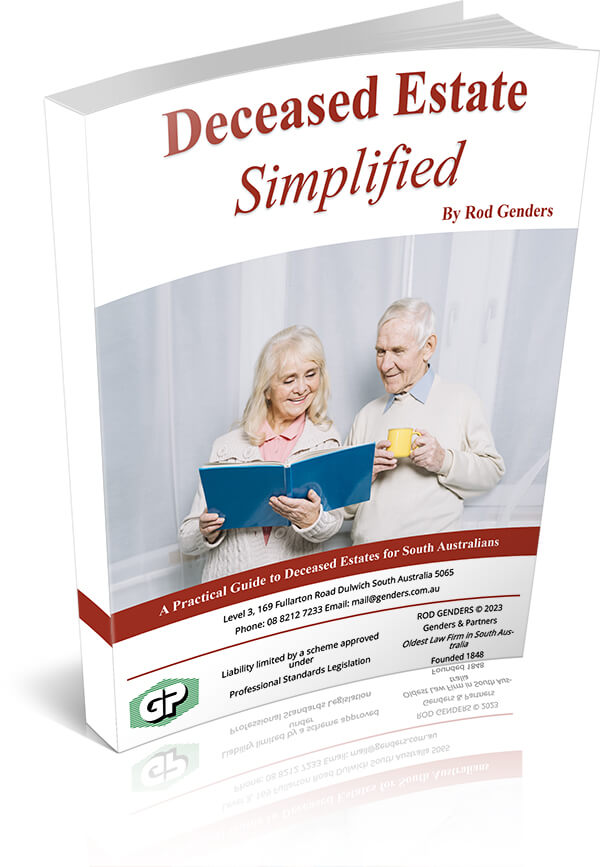
In this report you will learn:
- A simple, easy to understand explanation of the estate settlement process so you anticipate what’s to come and can plan your next steps.
- Detailed information on your duties and responsibilities as an Executor, Administrator or Personal Legal Representative of an estate.
- How to handle delicate situations with beneficiaries and dependents and what you can do to resolve conflict.
- What you need to do if the deceased did not have a will
- How to deal with personal effects, property, and taxes.