Updated: 5 November 2026
By Rod Genders | Genders and Partners | This article revised and updated 5 November 2026.

Could there ever be a legal expectation of a “use-by date” for human beings?
We might scoff at such a notion and relegate it to science fiction — but should we be so quick to dismiss it entirely?
The Cryogenics Question
Walt Disney is famously rumoured to have had his body cryogenically preserved at the moment of his death, in the hope that future medical science might one day revive him. Setting aside whether the rumour is true, the legal questions it raises are genuinely interesting: if a person of limited means wished to spend their entire estate on cryogenic preservation — at the cost of leaving nothing for their dependants — would the law permit it?
You might argue that the person is dead, and therefore has no further claim on the law’s protection of their wishes. But does death automatically extinguish all human rights? And if we accept that it might not — that some form of “self” persists while the possibility of revival remains — who has authority to make decisions on that person’s behalf?
What if You Are Not Yet Dead?
Consider a more immediate scenario: a person whose life is being sustained by medical technology, who has indicated a wish to be maintained in that state indefinitely in the hope of future medical advances. If they are still “alive” by any legal definition, should they be permitted to consume their own resources — including public resources via Medicare and Centrelink — without limit?
As a society, we already impose limits on the use of public resources. Certain life-sustaining medications and experimental treatments are not publicly funded. Organ donation allocation gives weight to expected longevity. Age limits apply to certain reproductive treatments funded under Medicare. These are all, in their way, judgements about the allocation of finite resources.
South Australia’s Own Response: Voluntary Assisted Dying
South Australia has already addressed one end of this spectrum. The Voluntary Assisted Dying Act 2021 (SA), which commenced on 31 January 2023, provides a carefully regulated framework for eligible persons who are experiencing intolerable suffering from an advanced and progressive terminal illness to request assistance to end their life. The Act contains stringent safeguards, including multiple assessments by specialist medical practitioners.
The Voluntary Assisted Dying Act 2021 (SA) and the Advance Care Directives Act 2013 (SA) together represent South Australia’s most considered legislative response to end-of-life decision-making. An Advance Care Directive allows a person to express their wishes about medical treatment (including life-sustaining treatment) and to appoint a substitute decision-maker. These documents are as much a part of an integrated estate plan as a Will.
Live Long and Prosper — But Plan for It
The late Leonard Nimoy — who died in February 2015 aged 83 — will be remembered by most of us as Spock, the relentlessly logical Vulcan in Star Trek. His catchphrase was “Live Long and Prosper.”
As Australians live longer than ever before, that slogan reflects a genuine challenge. People in their nineties now represent one of the fastest-growing demographic segments in the country. Longer lives mean longer periods of potential incapacity, more complex family situations, and a greater need for planning.
An integrated estate plan does not merely address what happens after your death. It addresses life: an Enduring Power of Attorney so that someone can manage your legal and financial affairs if you become incapacitated; an Advance Care Directive expressing your wishes about medical treatment; and a carefully drafted Will ensuring that your assets reach the people and causes you value.
The Debate Continues
The ethical questions surrounding life extension, the limits of public funding, and the allocation of scarce medical resources will intensify as technology advances. The community’s ability to pay for ever-increasing amounts of care, treatment, aged accommodation, and social welfare is not unlimited. These are questions for society as a whole to grapple with — but the time to put your own affairs in order is now, not when the debate is finally resolved.
This article revised and updated 5 November 2026.
Want to Find Out More?
If the questions raised in this article have prompted you to review your own life planning and estate arrangements, Genders and Partners are here to help. We specialise exclusively in Wills, Probate and Estate Planning in South Australia.
When it comes to Wills, Probate, Deceased Estates, asset protection and estate planning in Australia, you can trust the oldest law firm in South Australia – Genders & Partners – to guide you through the tough decisions to create the best solution for your individual needs.
If you have any questions or would like further information, or a quick phone call to discuss, book a timeslot for a free 15-minute phone consultation.
We can help you to protect yourself and your family. We look forward to being of service.
More Estate Planning and Life Planning Resources
- FAQs: Wills and Estate Planning
- Video Resources: Wills, Probate and Estate Planning
- End-of-Life Planning: Advance Care Directives in Adelaide
- Create an Integrated Estate Plan That Works
- The Right to Choose: Live or Die — an Adelaide Perspective
All these and many more estate planning and life planning topics are available for discussion with the oldest law firm in South Australia. Visit our articles page for further information.
DISCLAIMER: This article is intended as general philosophical commentary and information only. It does not constitute legal or medical advice. The Voluntary Assisted Dying Act 2021 (SA) and the Advance Care Directives Act 2013 (SA) contain complex requirements; you should seek specialist legal and medical advice before making any decisions under those Acts. All other estate planning matters should be discussed with a specialist estate planning lawyer. Liability limited by a scheme approved under Professional Standards Legislation.
SPECIAL REPORT “7 Things You Must Know Before You Make Your Will”
In this report you will Learn:
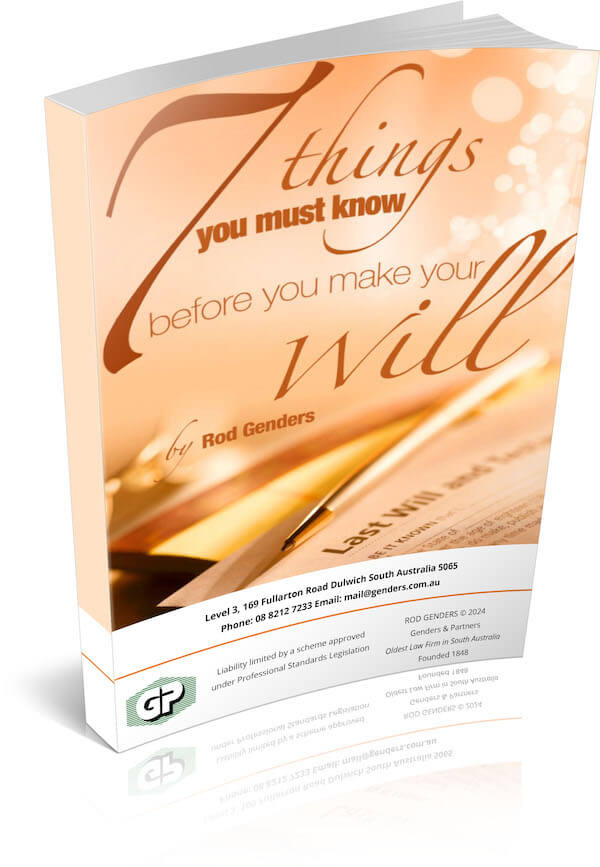
Why home-made Wills can be a LOT more expensive than you might think.
The secret weapons used by the rich & powerful to protect their assets, and transfer their wealth two or three generations ahead.
How Estate and Trustee Companies make BIG money from “free” Wills.
The Most Common Estate Planning Mistakes, how they can cost your family a fortune, and How to Avoid Them.
The Elements of a Sound Estate Plan – why a Will alone is not enough.
How to Make Sure Your Assets Stay in Your Family and are not lost to creditors, lawsuits or ex-spouses.
How to guard against challenges to your Estate after you’re gone.