
How to protect the power of your family trust and avoid the errors that erode its benefits
What is a Discretionary Family Trust and Why Does It Matter?
A discretionary family trust (often simply called a “family trust”) is one of the most powerful and flexible tools available in Australian estate planning. When established and managed correctly, it can protect assets from creditors and relationship breakdown, reduce the tax burden on distributions to beneficiaries, provide ongoing support for vulnerable family members, and simplify the administration of a deceased estate by avoiding probate in respect of trust-held assets.
However, a discretionary trust is only as effective as the care that goes into establishing it, funding it and maintaining it.
A family trust that is set up but not properly maintained is, in many respects, worse than no trust at all. It creates a false sense of security while the protections it was designed to provide quietly evaporate.
Mistake 1: Not Funding the Trust
This is, without question, the most common and most damaging trust mistake. A trust that has been established but not funded provides none of the asset protection or estate planning benefits that motivated its creation.
If you own your home, your investment properties, your share portfolio and your business interests in your own name, those assets will form part of your personal estate when you die. Assets properly held within a trust structure do not form part of your personal estate. They do not require probate. They are protected, subject to the terms of the trust deed, from your personal creditors.
Mistake 2: Allowing the Trust Deed to Become Outdated
Trust deeds are not static documents. A trust deed that was perfectly adequate in 2010 may be materially deficient in 2026. Common areas of concern with older trust deeds include:
- The definition of “beneficiaries” – which may not include children born after the deed was settled, or new spouses and partners
- Provisions relating to the vesting date – as the trust approaches its eighty-year vesting period, specific attention is required
- Distribution clauses that may be incompatible with current ATO guidance on trust streaming and franking credits
- Powers of the trustee that may be insufficient to deal with modern asset classes including cryptocurrency
Trust deeds should be reviewed by a legal adviser at least every five years, and immediately following any significant change in family circumstances or applicable law.
Mistake 3: Choosing the Wrong Trustee Structure
Individual trustees are problematic for a number of reasons. If the sole trustee dies, loses capacity or becomes bankrupt, the administration of the trust is immediately disrupted.
A corporate trustee – a company established specifically to act as trustee – eliminates most of these problems. The company continues to exist regardless of what happens to its directors and shareholders.
A corporate trustee is not merely a technical nicety. For any family trust expected to endure beyond the lifetime of its original settlor, it is close to essential.
Mistake 4: Confusing the Trust’s Assets with Personal Assets
A discretionary trust is a separate legal structure. Its assets belong to the trustee, not to the individual family members. This distinction is fundamental, and failing to maintain it has serious consequences. Practical steps to maintain the separation include:
- Maintaining a separate bank account in the trustee’s name for all trust transactions
- Never co-mingling trust funds with personal or business funds
- Ensuring all investments and contracts are executed in the name of the trustee, not in a personal capacity
Mistake 5: Failing to Make Annual Distributions
In Australia, the income of a discretionary trust that is not distributed to beneficiaries before the end of the financial year is typically taxed at the highest marginal rate. The resolution must be made in the correct form and be consistent with the trust deed.
Mistake 6: No Succession Plan for the Trust Itself
Who takes over when the current trustee or controller of the trust dies or loses capacity? A comprehensive estate plan should include:
- Updated trust deed provisions specifying how a new trustee is appointed and by whom
- A Will that deals with shares in the trustee company if a corporate trustee is used
- An Enduring Power of Attorney broad enough to cover actions taken in the trustee’s capacity
- A letter of wishes addressed to future trustees setting out how the settlor intended the trust to be administered
The Succession Act 2023 (SA), which commenced on 1 January 2025, significantly reformed succession law in South Australia – a timely reminder to review all estate planning documents including trust deeds and trustee company structures.
Mistake 7: Overlooking the Interaction with Family Law
A discretionary trust is not automatically immune from family law proceedings. The Full Court of the Family Court has made clear that trust assets can be treated as “resources” available to a party in property settlement proceedings. Trust deeds can be drafted or amended to include protective provisions that reduce (though do not eliminate) the risk of family law exposure. This is a specialised area requiring qualified advice.
Want to Find Out More?
If you would like further advice about your discretionary family trust, or if you are concerned that your trust structure is not working as intended, contact our friendly team.
When it comes to Wills, Probate, Deceased Estates, asset protection and estate planning in Australia, you can trust the oldest law firm in South Australia – Genders & Partners – to guide you through the tough decisions you must make for your family’s future care and welfare.
If you have any questions or would like further information, or a quick phone call to discuss, book a timeslot for a free 15-minute phone consultation.
We can help you to protect yourself and your family. We look forward to being of service.
More Trust and Asset Protection Resources
- FAQs
- Videos – Trusts and Asset Protection
- Articles about Discretionary Family Trusts
- Articles about Estate Planning Trusts
- Articles about Asset Protection and Estate Planning
All these and many more trust and asset protection topics are available for discussion with the oldest law firm in South Australia. Visit our articles page to explore our complete library of estate planning resources.
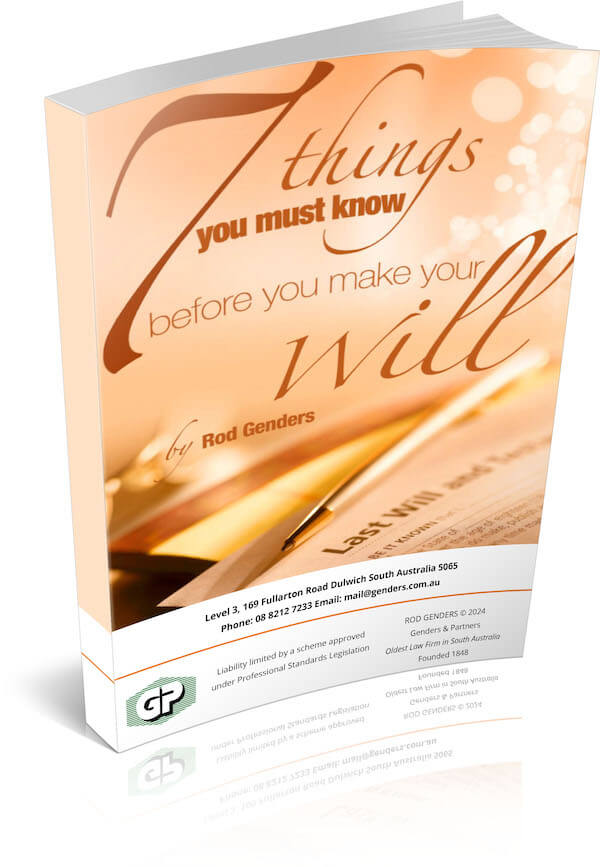
SPECIAL REPORT “7 Things You Must Know Before You Make Your Will”
In this report you will Learn:
Why home-made Wills can be a LOT more expensive than you might think.
The secret weapons used by the rich & powerful to protect their assets, and transfer their wealth two or three generations ahead.
How Estate and Trustee Companies make BIG money from “free” Wills.
The Most Common Estate Planning Mistakes, how they can cost your family a fortune, and How to Avoid Them.
The Elements of a Sound Estate Plan – why a Will alone is not enough.
How to Make Sure Your Assets Stay in Your Family and are not lost to creditors, lawsuits or ex-spouses.
How to guard against challenges to your Estate after you’re gone.