
When most people think about estate planning, they think about property, bank accounts, superannuation, and personal possessions. Few think about their email inbox, their cryptocurrency wallet, their Netflix subscription, or the thirty thousand photographs stored on a cloud service. Yet for many Australians in 2026, the digital estate is substantial — and it is almost entirely unplanned for.
What Is a Digital Asset?
A digital asset is any asset that exists in digital form and carries value — financial, sentimental, or practical. The categories are broad and growing.
- Financial digital assets: cryptocurrency, NFTs, online investment accounts, PayPal balances, digital banking
- Business digital assets: domain names, websites, online stores, digital intellectual property, software licences
- Social and content assets: social media accounts, YouTube channels, blogs, podcasts, digital photographs and videos
- Subscription and loyalty assets: streaming services, frequent flyer points, hotel loyalty programmes, cloud storage
- Personal records: emails, digital diaries, family history records, online accounts containing correspondence
The Cryptocurrency Access Problem
Of all digital assets, cryptocurrency presents the most acute estate planning challenge. Cryptocurrency held in self-custody — in a digital wallet controlled by the owner rather than held by an exchange — can only be accessed using private keys or seed phrases. If these credentials are not recorded and made available to executors, the cryptocurrency is permanently inaccessible. There is no bank to call, no password reset facility, and no regulatory authority to intervene.
A cryptocurrency wallet without a recorded seed phrase or private key is worthless to your estate. Record this information securely — and ensure a trusted person knows where to find it.
Can Your Will Deal with Digital Assets?
In principle, yes — digital assets that you legally own can be dealt with in your Will. However, many digital assets are not owned but licenced. You do not own your Netflix account; you have a licence to use the service. Most platform terms of service do not permit the transfer of account rights on death. A specific bequest of ‘my streaming account’ in your Will is likely to be ineffective.
Even where assets are legally transferable, your executor needs the practical means to access and deal with them. Account credentials, two-factor authentication devices, and platform-specific requirements can make digital estate administration practically impossible without advance planning.
Social Media After Death
The major social media platforms have introduced memorialisation features that allow accounts to be converted to a memorial state after death. Facebook and Instagram allow you to appoint a legacy contact who can manage the memorialised account. Google’s Inactive Account Manager allows you to specify what happens to your Google data after a period of inactivity. These platform-specific tools are separate from your Will and should be configured directly on each platform.
Online Business Succession
For business owners with a significant online presence — an e-commerce store, a content creation business, or a domain portfolio — the digital estate may be the most valuable component of the business. Business succession planning must include an inventory of all digital assets, the credentials required to access and transfer them, and a clear plan for how the business is to be managed or wound up in the event of death or incapacity.
Preparing Your Digital Asset Plan
The single most important step you can take is to prepare a digital asset register — a secure document that records all of your significant digital assets, the credentials required to access them, and the instructions for your executor.
- List every account, wallet, and platform that has financial or sentimental value
- Record usernames, passwords, and two-factor authentication methods in a secure, encrypted format
- Record cryptocurrency seed phrases and private keys with the greatest possible security
- Specify what you want done with each asset — transferred, memorialised, donated, or closed
- Store the register separately from your Will (the Will becomes public on probate) but ensure your executor knows where to find it
Important: Never include passwords or seed phrases in your Will. The Will becomes a public document on probate. Store sensitive credentials securely and separately.
Conclusion
The digital estate is a new frontier in succession law, and the law has not kept pace with the technology. The practical steps you take today — recording credentials, configuring platform tools, and briefing your executor — are more important than any legislative provision. Do not leave your digital life to chance.
Want to Find Out More?
If you would like further advice about digital assets and estate planning, or how to ensure your executor can access and manage your digital estate, contact our friendly team.
When it comes to Wills, Probate, Deceased Estates, asset protection and estate planning in Australia, you can trust the oldest law firm in South Australia – Genders & Partners – to guide you through the tough decisions you must make for your family’s future care and welfare.
If you have any questions or would like further information, or a quick phone call to discuss, book a timeslot for a free 15-minute phone consultation.
We can help you to protect yourself and your family. We look forward to being of service.
More Digital Asset and Estate Planning Resources
- FAQs
- Videos – Wills and Estate Planning
- Articles about Wills and Estate Planning
- Articles about Deceased Estates and Estate Administration
- Articles about Digital Assets and Estate Planning
All these and many more digital asset and estate planning topics are available for discussion with the oldest law firm in South Australia. Visit our articles page to explore our complete library of estate planning resources.
DISCLAIMER: This article is intended as general information only and does not constitute legal advice. The law relating to digital assets and estate planning is evolving rapidly and individual circumstances differ significantly. You should obtain specific legal advice from a qualified practitioner before taking or refraining from any action. Genders and Partners accepts no liability for reliance on this article without such advice.
5 Common Dangers in Using DIY Kits
To access this infographic click Here
Rod Genders is a senior Australian lawyer specialising in trusts, Wills and estate planning, accident compensation, and probate and deceased estate administration in Adelaide and all over South Australia. His boutique specialist law firm, which was founded on 1848, is one of the oldest and most respected in Australia. Rod is also a prolific author and speaker. Some of his articles and books on Wills, Probate, Trusts, Estate Planning, Asset Protection and Retirement Planning may be found at www.genders.com.au.
Enjoy this article? Check out the full report containing “A Guide for Beneficiaries of a Deceased Estate in South Australia” from senior Australian lawyer Rod Genders.
FREE REPORT “Deceased Estates Simplified”
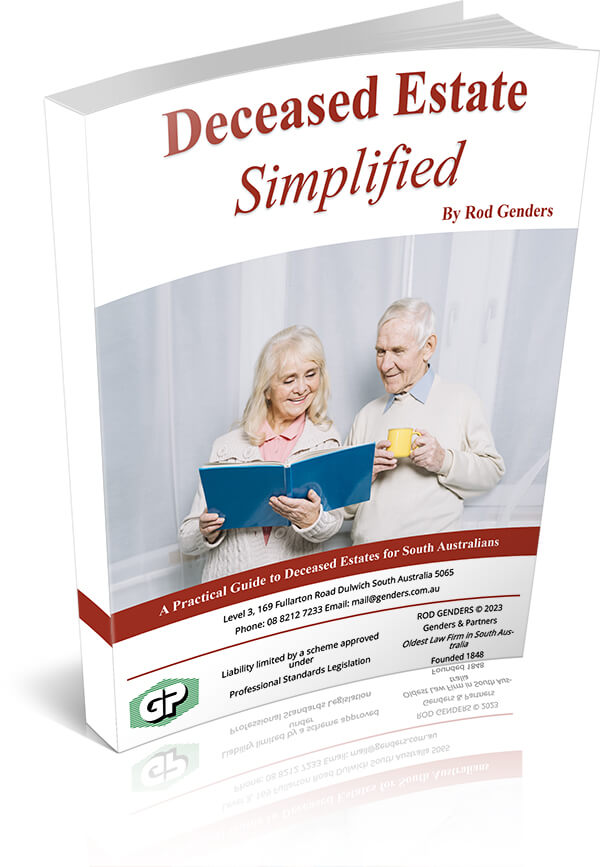
In this report you will learn:
- A simple, easy to understand explanation of the estate settlement process so you anticipate what’s to come and can plan your next steps.
- Detailed information on your duties and responsibilities as an Executor, Administrator or Personal Legal Representative of an estate.
- How to handle delicate situations with beneficiaries and dependents and what you can do to resolve conflict.
- What you need to do if the deceased did not have a will
- How to deal with personal effects, property, and taxes.