Updated: 5 November 2026
By Rod Genders | Genders and Partners | This article revised and updated 5 November 2026.

An Executor is the person appointed in a Will with the lawful authority to administer the deceased estate. The role carries a special responsibility — known in law as a fiduciary duty — to hold the estate in trust for the beneficiaries and to act at all times in the best interests of the estate.
Being named as an Executor can feel like an honour. It is also a significant legal responsibility, with real personal risk for those who make mistakes. Here are seven things every Executor should do.
1. Consult a Senior Lawyer Who Specialises in Deceased Estates
Unless the Will expressly directs otherwise, the Executor has the discretion to choose their own legal adviser — and this is one decision that genuinely matters. A specialist succession lawyer will administer the estate more efficiently, protect the Executor from personal liability, and ensure that the estate complies with all legal requirements under the Succession Act 2023 (SA).
Probate and deceased estate administration is a specialist area of law. A lawyer who primarily practises in family law or conveyancing is unlikely to have the detailed knowledge required to navigate the complexities of estate administration in South Australia. The cost of specialist advice is almost always recovered through the time saved and the mistakes avoided.
There are five distinct types of deceased estate administration in South Australia, and Probate is not always required in every estate. Did you know that some estates can be administered without Probate?
2. Identify and Secure the Estate Assets
The Executor is responsible for locating, protecting and securing all assets of the estate before any distribution is made. In the period between death and the grant of Probate, the Executor acts in a caretaker capacity — safeguarding the estate for the beneficiaries.
This includes checking and maintaining insurance on vacant property, making inquiries at banks and financial institutions, and determining which assets actually form part of the probatable estate. Some assets — such as property held as joint tenants, superannuation with valid beneficiary nominations, or assets held on trust — pass outside the estate and are not subject to Probate.
Executors who fail to properly locate and protect estate assets may be held personally liable to beneficiaries for any resulting loss.
3. Understand the Scope of Your Duties
The duties and responsibilities of an Executor are substantial, and the apparent simplicity of an estate can be deceptive. Estate litigation is expensive and can continue for years. When money is at stake, beneficiaries sometimes sue Executors for mistakes or delay — including mistakes that were made with the best of intentions.
In most cases, a privately appointed Executor cannot charge for their time unless the Will expressly authorises this or the Court so orders. Executors are entitled — and are strongly encouraged — to engage a specialist lawyer to assist with administration. This is not a luxury: it is prudent risk management.
4. Keep Proper Records
An Executor is required to account to the Court and to the beneficiaries for all assets received and disbursements made. Courts require Executors to provide a full accounting of the estate, and beneficiaries are entitled to request this information at any time.
Poor record-keeping is one of the most common sources of disputes in estate administration. Executors should maintain comprehensive records from the very outset, with dates, amounts, and the purpose of every transaction clearly documented. The protection this provides — should a beneficiary later challenge the administration — is invaluable.
5. Identify All Liabilities and Pay Taxes
An Executor can become personally liable if estate assets are distributed before all debts, liabilities and tax obligations have been discharged. This includes any income tax returns outstanding at the time of death, and the deceased’s return for the year of death.
Tax returns for deceased estates can take many months to be finalised and accepted by the Australian Taxation Office. Distributing estate funds before the final tax position is known is a very common — and very serious — mistake.
6. Be Cautious About Opening a Separate Estate Bank Account
Banks routinely encourage Executors to open a new estate bank account as soon as the deceased’s death is notified. What the bank may not disclose is that:
- If you engage a specialist lawyer, the lawyer’s statutory trust account can be used for this purpose at no additional cost.
- A new estate account requires a separate Tax File Number.
- Estate bank accounts attract fees and charges, and you will likely be unable to withdraw from the account until after Probate is granted — which may be months away.
- The deceased’s existing accounts are effectively frozen at the date of death in any event, and transfers between accounts cannot generally be made until after Probate.
7. Do Not Distribute the Estate Too Soon
Premature distribution of estate funds is one of the most common and costly mistakes made by Executors. Under the Succession Act 2023 (SA), eligible persons have a right to make a Family Provision claim against an estate for adequate provision from the estate. If the estate has been distributed before the limitation period for such claims has expired, the Executor may be personally liable to make good the shortfall.
Similarly, unknown creditors and unresolved tax liabilities can surface after an apparently straightforward administration. A specialist estate planning lawyer will advise you on the appropriate timing for distribution and how to protect yourself in the interim.
If you have been appointed as Executor, or know someone who has, Genders and Partners offer a cost-effective and comprehensive estate administration service. Our specialist consultants can attend at a location convenient to you. Contact us on (08) 8212 7233.
Want to Find Out More?
Executors who engage specialist legal assistance protect themselves, protect the estate, and protect their relationships with the beneficiaries. Genders and Partners have specialised in Wills, Probate and Estate Planning in South Australia for over 175 years.
When it comes to Wills, Probate, Deceased Estates, asset protection and estate planning in Australia, you can trust the oldest law firm in South Australia – Genders & Partners – to guide you through the tough decisions to create the best solution for your individual needs.
If you have any questions or would like further information, or a quick phone call to discuss, book a timeslot for a free 15-minute phone consultation.
We can help you to protect yourself and your family. We look forward to being of service.
More Executor and Probate Resources
- FAQs: Probate and Estate Administration
- Video Resources: Wills, Probate and Estate Planning
- The Different Types of Probate in South Australia
- What Does an Executor of a Deceased Estate Do?
- 12 Dangerous Stresses of Administering a Deceased Estate in SA
All these and many more executor and probate topics are available for discussion with the oldest law firm in South Australia. Visit our articles page for further information.
This article revised and updated 5 November 2026.
DISCLAIMER: This article is intended as general information only and does not constitute legal advice specific to any estate or individual. The duties and liabilities of Executors are complex and are governed in South Australia by the Succession Act 2023 (SA) and related legislation. You should obtain advice from a specialist estate planning and probate lawyer before acting in any capacity as an Executor. Liability limited by a scheme approved under Professional Standards Legislation.
FREE REPORT “7 Things You Must Know About Probate and Estate Administration”
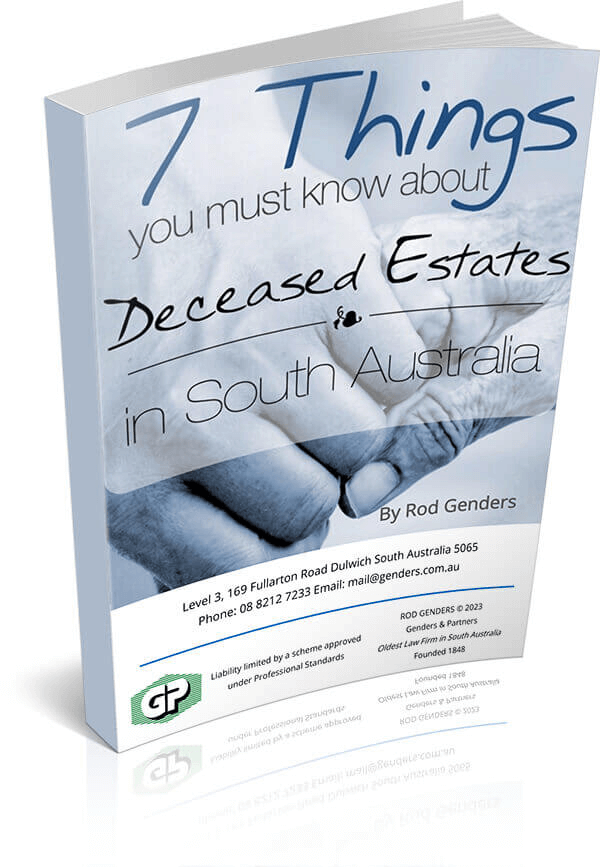
In this report you will Learn:
- What is Probate
- Duties of Executors
- Who Should Serve as Executor
- Executor’s Commissions
- Legal Fees and Expenses
- Sale of Real Estate and Other Property
- Challenges to the Will or Estate