
For many South Australians, the family home is the most valuable asset in their estate. It is also deeply personal – associated with decades of memory and, in many cases, currently occupied by a surviving spouse, a dependent child, an elderly parent, or another family member who has nowhere else to go. The prospect of that person being displaced shortly after the Will-maker’s death, because the home must be sold or transferred to satisfy the terms of the Will, is a genuine source of anxiety for many people making estate planning decisions.
The good news is that South Australian law under the Succession Act 2023 (SA) provides a range of flexible estate planning tools to address this concern, allowing a Will-maker to provide accommodation for a loved one after death without permanently alienating the property from its intended ultimate beneficiaries.
The Problem of Accommodation
The tension typically arises in one of the following situations:
- A surviving spouse or de facto partner who occupies the family home but has other assets of the estate to be shared among children from a prior relationship
- An adult child who lives in the family home as a carer for the deceased parent and has no other accommodation
- An elderly parent of the deceased who has been residing in the family home
- A dependent family member who needs time to find alternative accommodation and make financial arrangements
Without specific provision in the Will, the executor’s primary obligation is to administer the estate efficiently and distribute the assets to the beneficiaries in accordance with the Will’s terms. If the home is to be shared between multiple beneficiaries, the executor may have no alternative but to sell it, regardless of the impact on its occupants.
A Right of Residency in a Will
The most common tool for addressing this problem is a right of residency (or life estate) created by the Will. A right of residency grants a named person (the occupant or “Tenant” in the terms of the trust) the right to reside in the property for a defined period or for the remainder of their life, after which the property passes to the ultimate beneficiaries named in the Will (the “Remaindermen”).
This can be structured either as a direct right of residency under the terms of the Will, or as a testamentary trust over the property. The testamentary trust structure – available under the Succession Act 2023 (SA) – is generally more flexible and protective, as it separates legal ownership from beneficial occupation and allows the trust’s terms to be tailored to the specific circumstances.
How the Arrangement Works
Under a testamentary trust for accommodation, the property is transferred to the trustee upon the testator’s death. The trustee holds the property in accordance with the terms of the Will for the benefit of the occupant. The trustee cannot sell the property without the occupant’s consent during the period of occupancy (subject to the specific terms of the Will).
When the period of occupancy ends – whether on the death of the occupant, their voluntary departure, or the expiry of a fixed period – the trustee is obliged to transfer the property to the Remaindermen, who are the ultimate beneficiaries under the Will.
Setting Conditions on the Right of Residency
A well-drafted right of residency includes conditions that protect both the occupant and the estate. Typical conditions include:
- An obligation on the occupant to maintain the property in good repair and condition
- A requirement that the occupant insure the property in an amount acceptable to the trustee
- An obligation on the occupant to pay all outgoings, including rates, taxes, water charges, and strata levies (if applicable)
- A provision as to whether the occupant is required to pay a nominal rent to the trust (which can be appropriate in some tax-planning contexts)
- A prohibition on the occupant subletting or granting any other rights over the property without the trustee’s consent
- Provisions dealing with what happens if the occupant ceases to use the property as their primary residence
These conditions ensure that the property is maintained in an appropriate state for the Remaindermen when the occupancy ends, and that the trust does not bear obligations that the occupant could reasonably meet.
The Interests of the Remaindermen
In structuring a right of residency, it is important to consider the interests of the Remaindermen as well as those of the occupant. The Remaindermen hold a vested remainder interest in the property – they are entitled to receive it at the end of the occupancy, but they cannot compel its sale or take possession until that time. Their interest is proprietary and may be noted on the title to the property, providing security against dealings that might otherwise affect their position.
Where the Remaindermen are also entitled to income from the estate (for instance, where they are also beneficiaries of a testamentary trust over other estate assets), the Will should be carefully drafted to ensure that the accommodation arrangement does not inadvertently deprive them of income to which they are entitled during the period of occupancy.
Blended Families and the Right of Residency
The right of residency is particularly useful in blended family situations, where a Will-maker wishes to provide for a surviving spouse or de facto partner while ensuring that the family home ultimately passes to children from a prior relationship. It enables a balance to be struck between the competing interests of the current family and the prior family, without requiring the immediate sale of the home.
However, this arrangement can generate tension between the surviving spouse and the children who are Remaindermen, particularly if the occupancy is expected to last for many years. Clear drafting, careful trustee selection, and – where appropriate – advance communication with all parties can reduce the risk of future conflict.
Seeking Professional Guidance
Providing accommodation for a loved one through a Will requires careful legal drafting and a thorough understanding of the estate’s assets, the occupant’s needs, and the Remaindermen’s interests. An improperly drawn right of residency can generate disputes, expose the estate to unexpected tax consequences, or fail to achieve the Will-maker’s intentions. The involvement of an experienced estate planning solicitor is essential.
Want to Find Out More?
Genders and Partners has extensive experience helping South Australians with providing accommodation through Wills and testamentary trusts. Whether you are making a new Will, reviewing an existing one, or seeking advice on a specific estate planning concern, our specialist team is here to assist.
When it comes to Wills, Probate, Deceased Estates, asset protection and estate planning in Australia, you can trust the oldest law firm in South Australia – Genders & Partners – to guide you through the tough decisions to create the best solution for your individual needs.
If you have any questions or would like further information, or a quick phone call to discuss, book a timeslot for a free 15-minute phone consultation.
We can help you to protect yourself and your family. We look forward to being of service.
More Estate Planning Resources
- Wills and Estate Planning FAQs
- What Are Testamentary Trusts?
- How Estate Planning Trusts Can Protect You and Yours
- Estate Planning for Blended Families in South Australia
- The Responsibilities of a Trustee in South Australia
- Estate Planning for Problem Children
All these and many more estate planning topics are available for discussion with the oldest law firm in South Australia.
DISCLAIMER: This article provides general information about rights of residency and accommodation arrangements in Wills under the Succession Act 2023 (SA). It does not constitute legal advice. Tax and duty implications of life estates and rights of residency can be complex and are beyond the scope of this article. Readers should seek advice from a qualified South Australian estate planning practitioner.
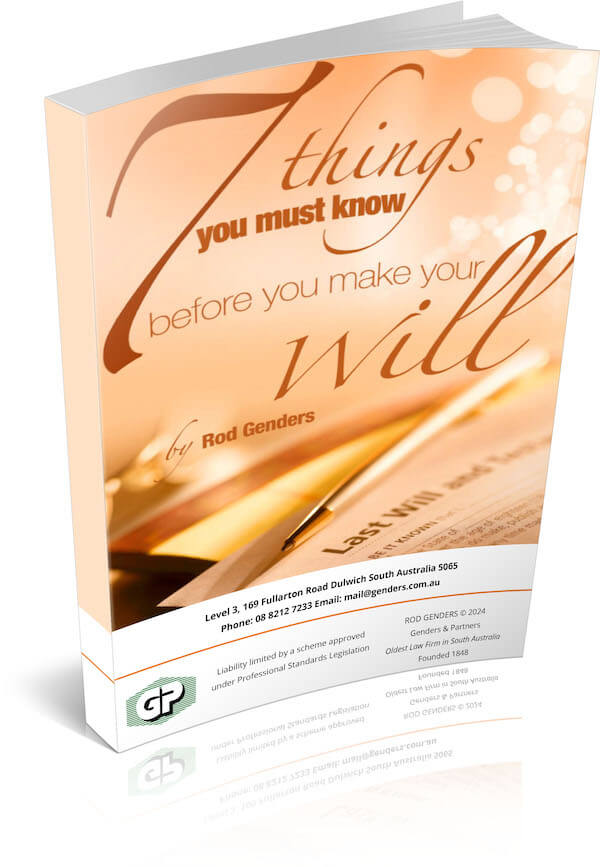
SPECIAL REPORT “7 Things You Must Know Before You Make Your Will”
In this report you will Learn:
Why home-made Wills can be a LOT more expensive than you might think.
The secret weapons used by the rich & powerful to protect their assets, and transfer their wealth two or three generations ahead.
How Estate and Trustee Companies make BIG money from “free” Wills.
The Most Common Estate Planning Mistakes, how they can cost your family a fortune, and How to Avoid Them.
The Elements of a Sound Estate Plan – why a Will alone is not enough.
How to Make Sure Your Assets Stay in Your Family and are not lost to creditors, lawsuits or ex-spouses.
How to guard against challenges to your Estate after you’re gone.