
Modern family structures are more complex than at any previous time. Many Australians have children from more than one relationship, and may be in a subsequent marriage or domestic partnership with a partner who also has children of their own. Without careful estate planning, the competing interests of these various family members can produce outcomes upon your death that would cause you considerable distress if you could foresee them. This article explains why a well-drafted Will is indispensable for anyone with children from a previous relationship.
The Problem of Competing Claims
When a person with children from a previous relationship dies, their estate may be the subject of competing claims from multiple parties:
- A current spouse or domestic partner, who may be entitled to a substantial share of the estate under the intestacy provisions of the Succession Act 2023 (SA), and who may also make a family provision application if they consider the provision made insufficient
- Children from the previous relationship, who similarly have standing to make a family provision application and whose interests must be considered
- Children of the current relationship, if any, whose interests may differ from those of step-siblings
Without a Will, the distribution of your estate will be determined by the intestacy rules of the Succession Act 2023 (SA). The statutory formula will allocate assets between your surviving spouse or domestic partner and your children in fixed proportions that may or may not align with your wishes — and may leave children from a previous relationship with less than you would have wanted them to receive.
How the Succession Act 2023 (SA) Affects Blended Families
The Succession Act 2023 (SA), which commenced on 1 January 2025, consolidates and reforms South Australian succession law. Under Part 3 of the Act, certain eligible persons — including a spouse or domestic partner, children, and other dependants — may apply to the court for provision or further provision from a deceased estate if they consider that the Will (or the intestacy rules) has not made adequate provision for their proper maintenance, education, or advancement in life.
The risk of a family provision application is heightened in blended family situations, where the tension between the interests of a current partner and children of a previous relationship is structural rather than exceptional. A specialist estate planning lawyer can advise on strategies to reduce this risk and to document the reasoning behind the distribution you have chosen, which can be relevant evidence if a challenge is subsequently made.
The Effect of Marriage and Divorce on Your Will
Under the Succession Act 2023 (SA), a subsequent marriage does not automatically revoke a Will made before the marriage — a significant change from the position under the former Wills Act 1936 (SA). However, a Will should always be reviewed and if necessary updated upon marriage, as the new spouse immediately becomes an eligible person for the purposes of a family provision application.
A decree absolute of divorce revokes any gift to, or appointment of, a former spouse under a Will, unless the Will clearly states that the gift or appointment is to survive divorce. Other provisions of the Will remain intact. This means that a Will made during a marriage may, after divorce, distribute your estate in a manner you never intended — reinforcing the importance of reviewing and updating your Will whenever your relationship status changes.
Testamentary Trusts as a Protective Mechanism
A testamentary trust established under your Will is one of the most effective mechanisms for protecting the inheritance of children from a previous relationship. By directing the children’s share of your estate into a trust rather than to them absolutely, you can:
- Ensure the funds are managed by a trustee you have specifically chosen and trust
- Protect the inheritance from claims by the children’s future creditors or divorcing spouses
- Provide for the staged distribution of capital as the children mature, rather than delivering a lump sum at age eighteen
- Reduce the risk that funds intended for children from a previous relationship are diverted to others
Mutual Wills and Life Interest Arrangements
Some couples in second or subsequent relationships choose to make mutual Wills — Wills made pursuant to a binding agreement not to revoke without the consent of the other, typically designed to provide for a surviving partner during their lifetime while preserving capital for the children of the first relationship. Mutual Will arrangements require careful specialist drafting to be effective and to avoid the unintended consequences that can arise from poorly structured provisions.
An alternative is a life interest arrangement, under which the surviving partner is given the right to occupy the family home (or to receive the income from other assets) for their lifetime, with the capital reverting to the children on the survivor’s death. Such arrangements require detailed consideration of the circumstances and expectations of all parties.
Keeping Your Will Under Review
The estate planning needs of blended families are not static. The birth of further children, the death of a former partner, changes in the financial circumstances of beneficiaries, and changes in the law all have the potential to affect the adequacy of an existing Will. A regular review with a specialist estate planning solicitor — every three to five years, or whenever circumstances change significantly — is strongly recommended.
Want to Find Out More?
Protecting children from previous relationships requires careful, specialist drafting. At Genders and Partners, we have extensive experience in estate planning for blended families and can help you put in place arrangements that are fair to everyone you care about.
When it comes to Wills, Probate, Deceased Estates, asset protection and estate planning in Australia, you can trust the oldest law firm in South Australia – Genders & Partners – to guide you through the tough decisions to create the best solution for your individual needs.
If you have any questions or would like further information, or a quick phone call to discuss, book a timeslot for a free 15-minute phone consultation.
We can help you to protect yourself and your family. We look forward to being of service.
More Resources on Blended Families and Estate Planning
- Planning for Blended Families
- Estate Planning After Relationship Breakdown
- Estate Planning Tips: Caring for Kids After Separation
- What Are Testamentary Trusts?
- Wills and Estate Planning FAQs
All these and many more related topics are available for discussion with the oldest law firm in South Australia. Visit the Genders and Partners article library for further reading.
| DISCLAIMER:
This article provides general information only and does not constitute legal advice. The law referred to is that of South Australia, with principal reference to the Succession Act 2023 (SA) (commenced 1 January 2025). References to family provision are general in nature; outcomes depend upon the particular facts and circumstances of each case. Readers should obtain advice from a qualified legal practitioner before acting. |
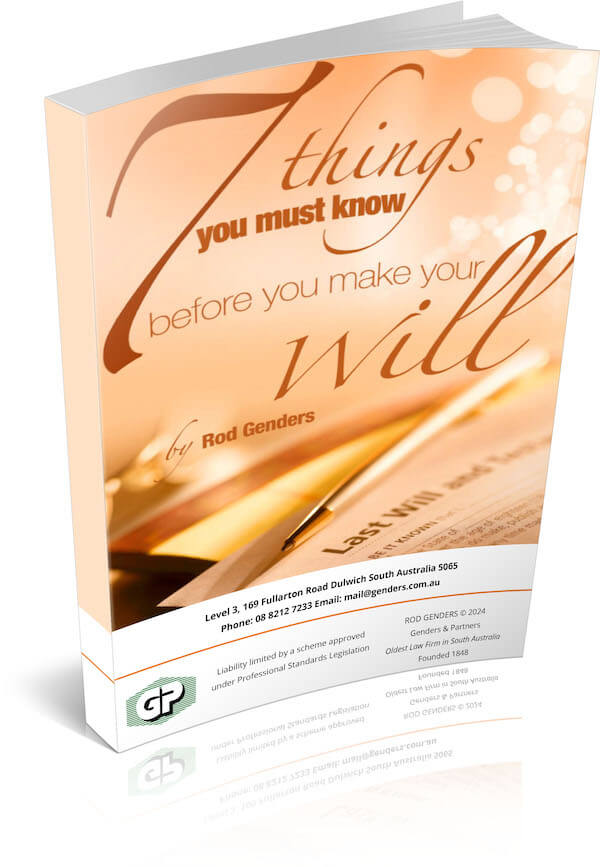
SPECIAL REPORT “7 Things You Must Know Before You Make Your Will”
In this report you will Learn:
Why home-made Wills can be a LOT more expensive than you might think.
The secret weapons used by the rich & powerful to protect their assets, and transfer their wealth two or three generations ahead.
How Estate and Trustee Companies make BIG money from “free” Wills.
The Most Common Estate Planning Mistakes, how they can cost your family a fortune, and How to Avoid Them.
The Elements of a Sound Estate Plan – why a Will alone is not enough.
How to Make Sure Your Assets Stay in Your Family and are not lost to creditors, lawsuits or ex-spouses.
How to guard against challenges to your Estate after you’re gone.