
Financial abuse of older Australians is more prevalent than most people realise, and its consequences can be devastating. An elderly person who has spent a lifetime accumulating assets may find those assets stripped away through manipulation, deception, or outright theft — often by someone they trusted completely. Understanding what elder financial abuse looks like, how it happens, and what the law provides by way of protection is a vital first step for every family.
What Is Elder Financial Abuse?
Elder financial abuse occurs when someone uses an older person’s money, property, or other assets without their informed consent, or by exploiting their trust, dependency, or diminished capacity. It encompasses a wide spectrum of conduct, from the relatively subtle — such as pressuring an elderly parent to change their Will — to the brazenly criminal, including outright theft of funds or forging a signature on a transfer of title.
Common forms of elder financial abuse include:
- Misuse of an enduring power of attorney (EPA), where an attorney makes gifts or transfers to themselves or others that the donor would not have authorised.
- Undue influence over Will-making, sometimes called testamentary undue influence, where a family member or carer pressures an older person to alter their estate plan in that person’s favour.
- Unauthorised withdrawals from bank accounts or investment portfolios.
- Persuading an elderly person to sign documents — including transfers of property or guarantees of debt — they do not understand.
- Charging excessive fees for care or services, or simply failing to account for money held on behalf of an older person.
Financial abuse does not require violence or even overt hostility. It frequently occurs within relationships of affection and trust, which makes it both easier to perpetrate and harder to detect.
Who Are the Perpetrators?
Research consistently shows that the most common perpetrators of elder financial abuse are family members — adult children, grandchildren, or other relatives — followed by intimate partners, carers, and, to a lesser extent, friends and neighbours. Professional service providers such as financial advisers and even lawyers occasionally appear in the statistics, though they represent a small minority.
This family-centred profile explains much of the difficulty in addressing elder financial abuse. Victims are often deeply reluctant to report a son or daughter to police, and family members who suspect abuse may be equally unwilling to confront a sibling or other relative. The shame and grief associated with discovering that a loved one has been exploited can be paralysing.
Professional advisers, including lawyers, have an important role to play. A competent estate planning solicitor will recognise the warning signs of undue influence or incipient financial abuse and take steps to ensure that a client’s instructions reflect their own genuine and informed wishes, free from external pressure.
Legal Protections in South Australia
South Australia has several overlapping legal frameworks relevant to elder financial abuse, and understanding how they interact is important.
Powers of attorney: An attorney appointed under an enduring power of attorney has strict fiduciary duties to act in the donor’s best interests, to keep proper accounts, and not to profit from the position. Breach of these duties can give rise to civil liability and, in serious cases, criminal prosecution for theft or fraud. The Office of the Public Advocate can investigate allegations of misuse and, where appropriate, apply to the South Australian Civil and Administrative Tribunal (SACAT) for orders to protect a vulnerable adult.
Testamentary undue influence: Under the Succession Act 2023 (SA), a Will may be challenged on the ground of undue influence where it can be shown that the testator’s freedom of decision was so overborne by another’s pressure that the resulting Will does not reflect the testator’s own intentions. Courts approach such challenges carefully — mere persuasion does not constitute undue influence — but where the evidence is compelling, the Court may set aside the affected gift or the entire Will.
Family provision claims: Where an elderly person has been manipulated into altering their estate plan to the disadvantage of other eligible persons, those persons may have recourse under the family provision provisions of the Succession Act 2023 (SA). A court may make provision out of the estate for an eligible claimant who has been inadequately provided for, regardless of the terms of the Will.
Important: If you suspect that an elderly relative’s estate plan has been altered under undue influence or financial abuse, seek independent legal advice promptly. Strict (and short) time limits apply to challenges under the Succession Act 2023 (SA) and delay can be fatal to a claim.
Prevention: The Best Protection
While the law provides remedies, prevention is far preferable to litigation. There are practical steps that older Australians and their families can take to reduce the risk of financial abuse.
- Appoint attorneys carefully: An enduring power of attorney (EPA) is one of the most powerful documents a person can sign. Your agent/attorney should be someone of unimpeachable integrity, ideally with financial competence. Consider appointing two attorneys to act jointly, so that neither can act unilaterally.
- The EPA deals with legal and financial matters, such as bank accounts, shares, real estate, government departments, insurances etc.
- An Advance Care Directive (ACD) is a different document that is also very important. It deals with accommodation, lifestyles, health care and medical decisions. The choice of Substitute Decision Makers under this document is important.
- Keep your estate plan current and documented: A Will prepared with the involvement of an experienced succession lawyer, and accompanied by a record of the instructions given, provides a contemporaneous account of your intentions that is far harder to challenge or manipulate.
- Maintain financial independence for as long as possible: Where practicable, keep control of your own financial accounts and do not give blanket access to others unless genuinely necessary.
- Communicate openly with family: Many estate planning disputes arise from surprise at the contents of a Will. A frank conversation about your intentions — while you have full capacity — can defuse tension and reduce the incentive for manipulation.
- Know your rights: SACAT can make orders to protect adults with impaired decision-making capacity. The Office of the Public Advocate can be a powerful ally if abuse is suspected.
A well-drawn enduring power of attorney, prepared by a qualified solicitor with appropriate safeguards built in, is one of the most effective protections against financial abuse in later life. An EPA and an ACD are important components of a modern integrated estate plan.
What to Do If You Suspect Abuse
If you believe that you or someone you care about is the victim of elder financial abuse, the following steps are appropriate. Contact a solicitor experienced in succession law as a matter of urgency — an injunction may be available to freeze assets pending investigation.
Report the matter to the Office of the Public Advocate if the affected person has impaired decision-making capacity. Consider reporting to South Australia Police if criminal conduct is suspected. Contact the person’s bank or financial institution, which has its own obligations to protect vulnerable customers.
Time is often of the essence, because assets that have been transferred or dissipated may be difficult to recover. Do not allow embarrassment or family loyalty to delay action.
Conclusion
Elder financial abuse is a serious and growing problem in Australia. It inflicts not only financial harm but deep emotional wounds on its victims. The law provides meaningful protections, but prevention — through careful estate planning, thoughtful appointment of attorneys, and open family communication — is always the better course. Genders and Partners has been helping South Australians protect themselves and their families for generations, and we are well placed to assist you in putting the right safeguards in place.
Want to Find Out More?
If you would like further advice about protecting yourself or a loved one from elder financial abuse, or about your rights under a power of attorney or Will, contact our friendly team.
When it comes to Wills, Probate, Deceased Estates, asset protection and estate planning in Australia, you can trust the oldest law firm in South Australia – Genders & Partners – to guide you through the tough decisions you must make for your family’s future care and welfare.
If you have any questions or would like further information, or a quick phone call to discuss, book a timeslot for a free 15-minute phone consultation.
We can help you to protect yourself and your family. We look forward to being of service.
More Elder Law and Estate Planning Resources
- FAQs
- Videos – Powers of Attorney and Elder Law
- Enduring Powers of Attorney in South Australia
- Wills and Estate Planning – Overview
- Adelaide Lawyer Blog
All these and many more elder law and estate planning topics are available for discussion with the oldest law firm in South Australia. Visit our articles page to explore our complete library of estate planning resources.
DISCLAIMER: This article is intended as general information only and does not constitute legal advice. The law in this area is complex and the circumstances of each individual differ. You should obtain specific legal advice from a qualified practitioner before taking or refraining from any action. Genders and Partners accepts no liability for reliance on this article without such advice.
This article was prepared 24 April 2026.
5 Common Dangers in Using DIY Kits
To access this infographic click Here
Rod Genders is a senior Australian lawyer specialising in trusts, Wills and estate planning, accident compensation, and probate and deceased estate administration in Adelaide and all over South Australia. His boutique specialist law firm, which was founded on 1848, is one of the oldest and most respected in Australia. Rod is also a prolific author and speaker. Some of his articles and books on Wills, Probate, Trusts, Estate Planning, Asset Protection and Retirement Planning may be found at www.genders.com.au.
Enjoy this article? Check out the full report containing “A Guide for Beneficiaries of a Deceased Estate in South Australia” from senior Australian lawyer Rod Genders.
FREE REPORT “Deceased Estates Simplified”
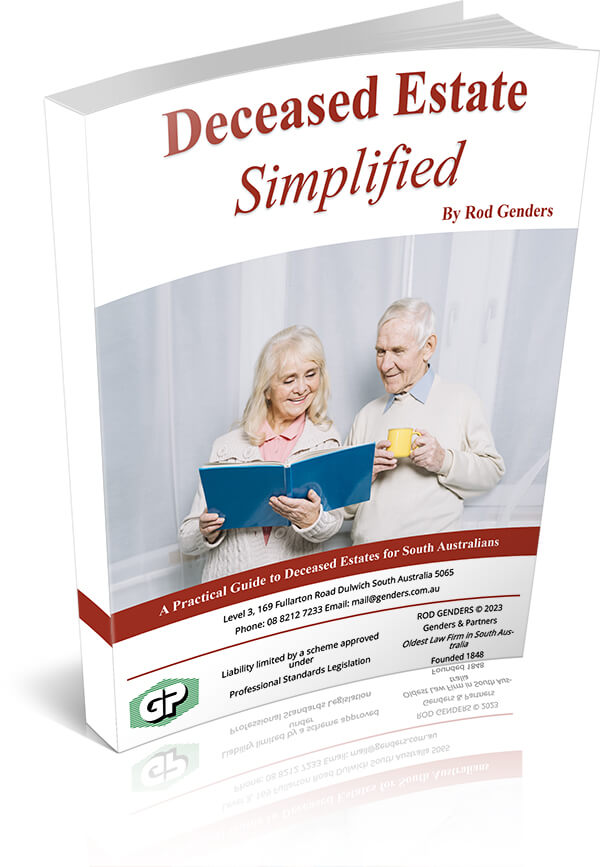
In this report you will learn:
- A simple, easy to understand explanation of the estate settlement process so you anticipate what’s to come and can plan your next steps.
- Detailed information on your duties and responsibilities as an Executor, Administrator or Personal Legal Representative of an estate.
- How to handle delicate situations with beneficiaries and dependents and what you can do to resolve conflict.
- What you need to do if the deceased did not have a will
- How to deal with personal effects, property, and taxes.