By Rod Genders | Genders and Partners

Most people assume that a Will is valid so long as it reflects what the will-maker wanted. In fact, South Australian law imposes strict formal requirements on how a Will must be signed and witnessed before it takes effect as a legally binding document.
Get the formalities wrong, and even a document that perfectly captures a person’s wishes can be at risk of failing – unless the Supreme Court is persuaded to step in and rescue it under what is known as the dispensing power. This article explains what the formal requirements are, what can go wrong, and how the courts have been given a discretion to overlook defects in appropriate cases.
The Formal Requirements Under the Succession Act 2023 (SA)
The Succession Act 2023 (SA), which now governs the making and interpretation of Wills in South Australia, sets out the formalities a Will must satisfy to be valid. In broad terms, a Will must be in writing, signed by the will-maker (or by someone else in their presence and at their direction), and that signature must be made or acknowledged in the presence of two or more witnesses who are present at the same time. Those witnesses must then also sign the Will in the presence of the will-maker.
These requirements exist for good reason. They provide a reliable, objective way of confirming that a document truly represents the considered and voluntary wishes of the will-maker, made while they had the mental capacity to do so, and reduce the risk of forgery, undue influence, or later dispute about what was intended.
In practice, however, things do not always go according to plan. A will-maker could attempt to sign a document at home without witnesses present, believing (wrongly) that a witnessed signature is not necessary. A solicitor’s file copy of unsigned instructions might more clearly express a person’s wishes than the document they eventually signed. A witness could leave the room before the will-maker signs. Or a person might leave behind an unsent text message, an email, or a note on their phone setting out how they wanted their estate distributed, without ever executing a formal Will at all.
What Happens When the Formalities Are Not Met
Historically, a document that did not meet the formal execution requirements was simply invalid, no matter how clearly it expressed the deceased’s intentions. That could produce harsh results – an estate might be distributed under the rules of intestacy, or under an earlier and now-outdated Will, even where there was strong evidence of what the deceased actually wanted.
Recognising this problem, South Australian law (mirroring reforms adopted in most other Australian states) now includes a dispensing power. This allows the Supreme Court to admit an informal document to probate as if it were a validly executed Will, provided the Court is satisfied that the document was intended by the deceased to constitute their Will, or an alteration or revocation of it.
How the Dispensing Power Works
The dispensing power is not a rubber stamp. An applicant must satisfy the Court, on the evidence, of two key matters:
- that there is a document (which can include an electronic record, a note, an unsent draft, or in some cases even an audio or video recording) that purports to state the testamentary intentions of the deceased; and
- that the deceased intended that particular document, without more, to operate as their Will (or as an amendment to, or revocation of, an existing Will).
The Court will examine the surrounding circumstances closely. Relevant evidence can include the language used in the document, whether it was signed or otherwise finalised in some way, whether the deceased told others of their intentions, whether earlier drafts were superseded, and how close in time the document was to the deceased’s death. A document that reads as a settled statement of intention (“this is my Will”) is far more likely to succeed than one that reads as a tentative note to be formalised later (“I must get around to sorting out a proper Will”).
Genuine tip: the dispensing power is a safety net for genuine mistakes and unforeseen circumstances – it is not a substitute for making a properly executed Will. Applications of this kind are expensive, uncertain, and add months (sometimes years) of delay and stress for grieving families.
Lessons for Your Own Estate Planning
The existence of the dispensing power should never be treated as a reason to delay proper estate planning. Litigation over informal documents is costly, adversarial, and far from certain – the Court must be persuaded on the evidence available, and family members can and do dispute what the deceased truly intended. The best protection remains a validly executed Will, prepared with proper legal advice, reviewed regularly, and stored securely where your executor can find it.
If you have used a DIY Will kit, drafted your own document, or made changes to an existing Will without legal advice, it is worth having the document reviewed to confirm it meets the formal requirements. A short consultation now is far cheaper, in every sense, than a Supreme Court application later.
Conclusion
The formal requirements for making a Will exist to protect will-makers and their families, not to trip them up. The dispensing power provides a valuable safeguard for genuine mistakes, but it is an uncertain and costly path compared with simply having a properly signed and witnessed Will in place. If you are at all unsure whether your Will – or a loved one’s – meets the formal requirements under the Succession Act 2023 (SA), we encourage you to seek advice sooner rather than later.
Want to Find Out More?
If you would like further advice about whether your Will meets the formal legal requirements, or about an informal document that may need to be relied upon after a loved one’s death, contact our friendly team.
When it comes to Wills, Probate, Deceased Estates, asset protection and estate planning in Australia, you can trust the oldest law firm in South Australia – Genders & Partners – to guide you through the tough decisions you must make for your family’s future care and welfare.
If you have any questions or would like further information, or a quick phone call to discuss, book a timeslot for a free 15-minute phone consultation.
We can help you to protect yourself and your family. We look forward to being of service.
More Wills and Estate Planning Resources
- FAQs
- Videos – Making and Updating Your Will
- Articles about Wills and estate planning
- Articles about testamentary trusts
- Our Adelaide lawyer blog
All these and many more Wills and estate planning topics are available for discussion with the oldest law firm in South Australia. Visit our articles page to explore our complete library of estate planning resources.
DISCLAIMER: This article is intended as general information only and does not constitute legal advice. Whether a document will be accepted by the Court under the dispensing power depends entirely on the specific facts and evidence available in each case. You should obtain specific legal advice from a qualified practitioner before taking or refraining from any action. Genders and Partners accepts no liability for reliance on this article without such advice.
This article was prepared 6 October 2026.
This article was last reviewed on 6 October 2026 and does not describe or capture any changes to the law after that date.
SPECIAL REPORT “7 Things You Must Know Before You Make Your Will”
In this report you will Learn:
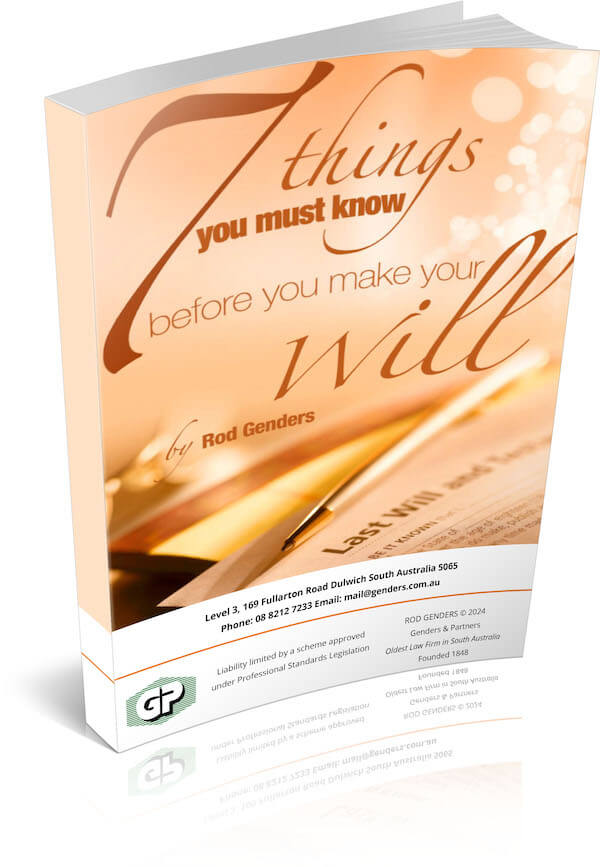
Why home-made Wills can be a LOT more expensive than you might think.
The secret weapons used by the rich & powerful to protect their assets, and transfer their wealth two or three generations ahead.
How Estate and Trustee Companies make BIG money from “free” Wills.
The Most Common Estate Planning Mistakes, how they can cost your family a fortune, and How to Avoid Them.
The Elements of a Sound Estate Plan – why a Will alone is not enough.
How to Make Sure Your Assets Stay in Your Family and are not lost to creditors, lawsuits or ex-spouses.
How to guard against challenges to your Estate after you’re gone.