
By Rod Genders | Genders and Partners
A Will represents the deceased’s wishes at the time it was made, but it is not always the final word on how an estate is actually distributed. Where all the relevant beneficiaries agree, it is often possible to vary the distribution set out in a Will (or under the rules of intestacy) by entering into a deed of family arrangement. This can be a faster, cheaper, and less adversarial alternative to a family provision claim or other estate litigation, but it comes with its own legal, tax, and practical considerations that are worth understanding before beneficiaries shake hands on an informal deal.
What Is a Deed of Family Arrangement?
A deed of family arrangement (sometimes called a deed of family settlement) is a formal, legally binding agreement between the beneficiaries of an estate – and usually the executor – to distribute the estate differently from how the Will or intestacy rules would otherwise require. It is not a court order and does not rewrite the Will itself; rather, it is a separate contract under which the beneficiaries agree to redirect some or all of their entitlements in a particular way, and release each other from any competing claims arising from that redistribution.
Because everyone affected must agree, a deed of family arrangement is only available where the relevant beneficiaries (and often the executor) are all willing participants. It cannot be used to override the wishes of a beneficiary who does not consent, and it is not a substitute for a family provision claim where a genuinely disappointed beneficiary is not prepared to reach agreement.
Common Situations Where a Deed May Be Used
- Correcting an unintended or unfair outcome that has arisen because a Will was not updated to reflect changed family circumstances.
- Resolving a looming or threatened family provision claim by agreement, without the cost, delay, and stress of court proceedings.
- Rebalancing gifts between siblings where one beneficiary already received significant support from the deceased during their lifetime.
- Redirecting an inheritance to a beneficiary’s children or to a testamentary trust for tax, asset protection, or social security reasons.
- Simplifying the distribution of jointly owned or hard-to-divide assets, such as a family property or business interest.
Formal Requirements and Practical Steps
A deed of family arrangement should be prepared as a formal, properly executed legal document, not a casual written or verbal understanding between family members. It should clearly identify the parties, set out the entitlements being varied, describe precisely what each party will receive instead, and include appropriate releases so that no party can later resile from the agreement or bring a further claim over the same assets. Independent legal advice for each beneficiary is strongly recommended, both to ensure the agreement reflects what each person actually intends and to reduce the risk of the deed later being challenged on the basis that a party did not properly understand what they were signing.
Practical tip: a deed of family arrangement is far easier to negotiate calmly before positions harden. Where family tension is anticipated, raising the possibility of a deed early, with everyone properly advised, is usually more productive than waiting until a dispute has escalated.
Tax and Duty Considerations
Varying how an estate is distributed can have capital gains tax, stamp duty, and social security consequences that would not have arisen had the original Will simply been followed. Depending on how the deed is structured and the timing of the arrangement, transfers made under a genuine deed of family arrangement may in some circumstances qualify for concessional treatment, but this is a highly technical area and the rules differ depending on the type of asset involved, particularly for real property and shares. Beneficiaries should obtain specific taxation advice before finalising any deed, rather than assuming that an agreement between family members will automatically be treated the same way as a distribution under the original Will.
The Executor’s Position
An executor is not automatically bound to agree to a proposed deed of family arrangement simply because the beneficiaries have reached an understanding among themselves. The executor’s overriding duty remains to administer the estate in accordance with the Will (or the rules of intestacy) and in the best interests of the estate as a whole, including any beneficiaries who are minors or otherwise unable to give informed consent. Where all adult beneficiaries with full capacity agree, executors will often support a sensible and properly documented arrangement, but they should still obtain their own advice before doing so, particularly where the estate includes vulnerable beneficiaries or complex assets.
When a Deed Is Not the Right Tool
A deed of family arrangement depends entirely on consensus. Where a beneficiary genuinely disagrees, or where a person who was left out of a Will believes they have a proper claim for further provision, a deed cannot be imposed on them, and the more appropriate pathway may be a family provision claim under the Succession Act 2023 (SA), mediation, or, ultimately, court proceedings. A deed is best understood as a tool for formalising agreement that already exists, or is close to being reached, rather than as a means of resolving entrenched conflict.
Conclusion
A deed of family arrangement can offer a practical, cost-effective way for a family to reach a fairer or more sensible outcome than a Will strictly provides, without the expense and strain of contested litigation. Because it involves permanently altering legal entitlements, however, it should always be approached with proper legal and taxation advice for everyone involved, and documented formally rather than left to an informal handshake agreement.
Want to Find Out More?
If you would like further advice about varying the distribution of an estate by agreement, or are considering a deed of family arrangement, contact our friendly team.
When it comes to Wills, Probate, Deceased Estates, asset protection and estate planning in Australia, you can trust the oldest law firm in South Australia – Genders & Partners – to guide you through the tough decisions you must make for your family’s future care and welfare.
If you have any questions or would like further information, or a quick phone call to discuss, book a timeslot for a free 15-minute phone consultation.
We can help you to protect yourself and your family. We look forward to being of service.
More Estate Administration and Family Provision Resources
- FAQs
- Videos – Estate Disputes and Family Provision Claims
- Articles about probate and estate administration
- Articles about Wills and estate planning
- Our Adelaide lawyer blog
All these and many more estate administration and family provision topics are available for discussion with the oldest law firm in South Australia. Visit our articles page to explore our complete library of estate planning resources.
DISCLAIMER: This article is intended as general information only and does not constitute legal or taxation advice. The tax, duty, and legal consequences of a deed of family arrangement depend heavily on individual circumstances and the assets involved. You should obtain specific advice from a qualified practitioner before taking or refraining from any action. Genders and Partners accepts no liability for reliance on this article without such advice.
This article was prepared 14 September 2026.
This article was last reviewed on 14 September 2026 and does not describe or capture any changes to the law after that date.
FREE REPORT “Deceased Estates Simplified”
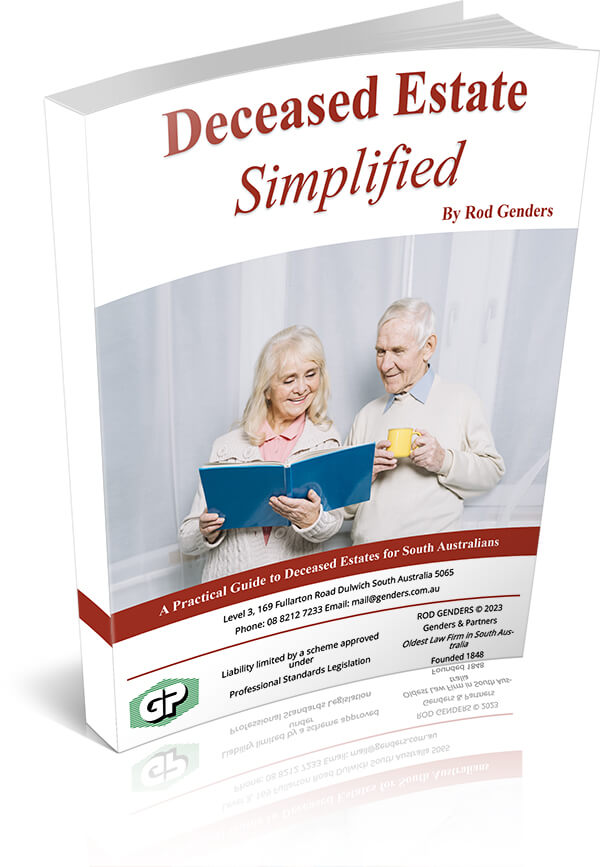
In this report you will learn:
- A simple, easy to understand explanation of the estate settlement process so you anticipate what’s to come and can plan your next steps.
- Detailed information on your duties and responsibilities as an Executor, Administrator or Personal Legal Representative of an estate.
- How to handle delicate situations with beneficiaries and dependents and what you can do to resolve conflict.
- What you need to do if the deceased did not have a will
- How to deal with personal effects, property, and taxes.