
For parents and carers of a person with a severe disability, the question of “what happens when I am no longer here?” can be one of the most anxious preoccupations of their lives. How will their loved one be cared for? Who will manage their affairs? Will a sudden inheritance disqualify them from means-tested government support? A Special Disability Trust (SDT) is a legal structure specifically designed to address these concerns, offering significant tax and social security advantages while providing a dedicated fund for a beneficiary’s care and accommodation needs.
What Is a Special Disability Trust?
A Special Disability Trust is a particular type of trust established under the Social Security Act 1991 (Cth) and related legislation to hold assets for the benefit of a person with a severe disability. The trust can be created during the lifetime of a parent or other close relative, or it may be established under a Will to take effect on the death of a testator. It can also receive gifts from eligible contributors while the beneficiary is still alive.
The defining characteristic of an SDT is its restriction to a single principal beneficiary. Unlike a discretionary testamentary trust, which can distribute income and capital among a range of family members, an SDT exists solely for the care, accommodation, and well-being of the one disabled beneficiary. That singular focus is the price of the very substantial concessions the structure attracts.
An SDT is an excellent estate planning tool. It is a long-term welfare and financial security mechanism for some of the most vulnerable members of our community.
Who Qualifies as a Beneficiary?
To be eligible as the principal beneficiary of an SDT, a person must have a severe disability or severe medical condition as defined under the Social Security Act 1991 (Cth). In broad terms, the person must have a disability that is likely to be permanent and must, because of that disability, have significant functional impairment such that they cannot work independently, require significant ongoing care, and cannot live independently without substantial support. The disability may be physical, intellectual, or psychiatric in nature.
A formal assessment and certification process applies. Services Australia (previously the Department of Human Services) administers the eligibility determination. It is important to obtain a proper assessment before establishing a trust, as an SDT that does not meet the definitional criteria will not attract the legislated concessions.
Note: The eligibility criteria are set at the federal level and apply uniformly across all Australian states and territories, including South Australia.
The Social Security Concession
The most significant practical benefit of an SDT is the social security exemption. Assets held within a qualifying SDT are exempt from the means test for the assets-based calculation of the principal beneficiary’s social security entitlements, up to a prescribed threshold (which is indexed periodically). Similarly, income earned by an SDT is not assessed as income of the beneficiary for the purposes of the income test. This means that a beneficiary can have substantial assets held in trust for their benefit without being disqualified from, or having their entitlements reduced under, disability support payments.
This is a transformative advantage. Without the protection of an SDT, a bequest to a person receiving disability support pension could reduce or extinguish that pension entirely, leaving the beneficiary worse off in terms of ongoing support. The SDT allows families to provide generously for a disabled person without inadvertently undermining their access to the government safety net.
Gifts made to an SDT by eligible contributors — defined to include parents, grandparents, siblings, and other close relatives — are also exempt from the gifting provisions of social security law, up to the prescribed limit per contributor. This allows relatives to make contributions to the trust over time without affecting their own Centrelink entitlements.
Tax Treatment
SDTs are subject to the ordinary trust taxation rules, with certain modifications. Distributions from the trust for the benefit of the principal beneficiary are treated as the income of the beneficiary in the year of distribution. Given that many SDT beneficiaries have little or no other taxable income, this treatment is often advantageous. Undistributed income in the trust is taxed at the highest marginal rate (as with other trusts), so careful distribution planning is important.
The trust itself does not attract the same tax concessions as a testamentary trust with infant beneficiaries, but the overall tax outcome for a family group with an SDT is often highly favourable compared with direct bequests or other trust structures.
What Can Trust Funds Be Used For?
Funds held in an SDT must be used for the care and accommodation needs of the principal beneficiary. The legislation defines these purposes broadly, covering reasonable care and accommodation costs including:
- Accommodation, whether rented, owned, or provided in a supported living facility.
- Modifications to a home to address the beneficiary’s disability-related needs.
- Medical, dental, and therapeutic care costs not covered by Medicare or the National Disability Insurance Scheme (NDIS).
- Aids and appliances required by reason of the disability.
- Costs of transport, education, and recreation that relate to the beneficiary’s care or quality of life.
Up to a modest prescribed annual amount may also be applied for discretionary purposes unrelated to care and accommodation — a provision that acknowledges the importance of quality of life beyond bare subsistence. Trustees should keep careful records of all expenditure to demonstrate compliance with the permitted purposes.
Trustees of an SDT have real obligations and real accountability. Poor record-keeping or expenditure outside the permitted purposes can jeopardise the trust’s exempt status. Professional trustee advice is strongly recommended.
Establishing an SDT: Key Considerations
An SDT can be established by deed during the lifetime of the founder, or by a testamentary provision in a Will. In either case, the trust deed must comply with the template approved by the relevant federal department and must be administered by a trustee who satisfies the eligibility requirements (generally a close family member, a registered organisation, or a professional trustee).
Several practical matters warrant consideration before establishment. First, the interaction between an SDT and NDIS funding requires careful attention. NDIS supports are assessed separately and are not affected by SDT assets, but the two regimes must be managed in a coordinated way. Second, if the principal beneficiary has siblings, an SDT does not prevent those siblings from being provided for under the same Will through other means, such as a testamentary discretionary trust for the residuary estate. Third, the death of the principal beneficiary requires careful planning: the trust deed must specify what is to happen to any remaining capital, and this destination must be consistent with the legislative requirements.
Finally, the interplay between an SDT and any EPOA or guardianship order affecting the beneficiary during their lifetime is an important consideration. If the beneficiary has a guardian or administrator appointed by SACAT, that appointment may affect how the trust is administered in practice.
Conclusion
A Special Disability Trust can be a profoundly valuable component of an estate plan where a family member with a severe disability needs long-term provision and protection. It combines financial security, social security exemption, and a framework for professional management of a vulnerable person’s affairs. Like all sophisticated trust structures, however, it requires careful design and ongoing administration. The team at Genders and Partners has the expertise to advise on whether an SDT is the right solution for your family’s circumstances and to assist with its establishment and ongoing governance.
Want to Find Out More?
If you would like further advice about Special Disability Trusts or estate planning for a loved one with a disability, contact our friendly team.
When it comes to Wills, Probate, Deceased Estates, asset protection and estate planning in Australia, you can trust the oldest law firm in South Australia – Genders & Partners – to guide you through the tough decisions you must make for your family’s future care and welfare.
If you have any questions or would like further information, or a quick phone call to discuss, book a timeslot for a free 15-minute phone consultation.
We can help you to protect yourself and your family. We look forward to being of service.
More Estate Planning and Trusts Resources
- FAQs
- Videos – Trusts and Estate Planning
- Testamentary Trusts – How They Can Protect Your Family
- Discretionary Trusts in Estate Planning
- Wills and Estate Planning – Overview
All these and many more estate planning trust topics are available for discussion with the oldest law firm in South Australia. Visit our articles page to explore our complete library of estate planning resources.
DISCLAIMER: This article is intended as general information only and does not constitute legal advice. The law in this area is complex and the circumstances of each individual differ. You should obtain specific legal advice from a qualified practitioner before taking or refraining from any action. Genders and Partners accepts no liability for reliance on this article without such advice.
This article was prepared 24 April 2026.
5 Common Dangers in Using DIY Kits
To access this infographic click Here
Rod Genders is a senior Australian lawyer specialising in trusts, Wills and estate planning, accident compensation, and probate and deceased estate administration in Adelaide and all over South Australia. His boutique specialist law firm, which was founded on 1848, is one of the oldest and most respected in Australia. Rod is also a prolific author and speaker. Some of his articles and books on Wills, Probate, Trusts, Estate Planning, Asset Protection and Retirement Planning may be found at www.genders.com.au.
Enjoy this article? Check out the full report containing “A Guide for Beneficiaries of a Deceased Estate in South Australia” from senior Australian lawyer Rod Genders.
FREE REPORT “Deceased Estates Simplified”
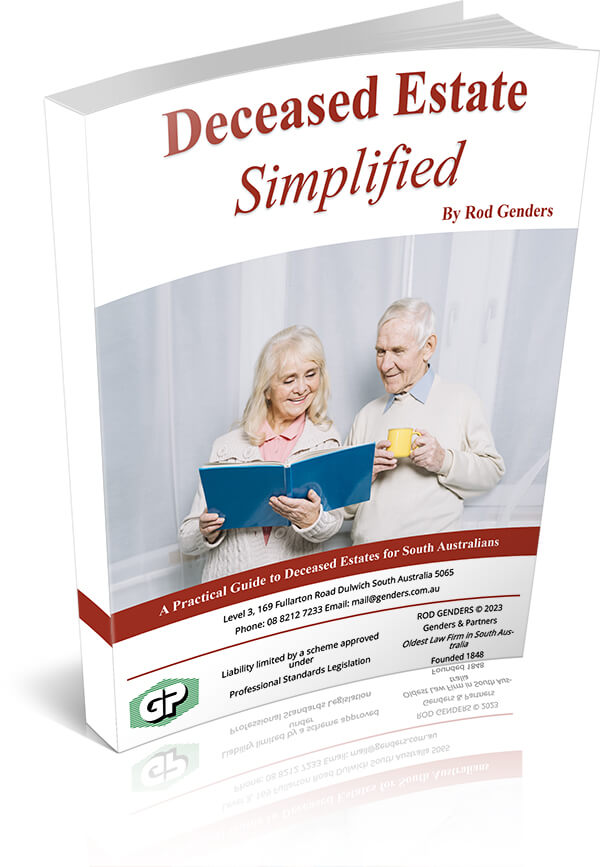
In this report you will learn:
- A simple, easy to understand explanation of the estate settlement process so you anticipate what’s to come and can plan your next steps.
- Detailed information on your duties and responsibilities as an Executor, Administrator or Personal Legal Representative of an estate.
- How to handle delicate situations with beneficiaries and dependents and what you can do to resolve conflict.
- What you need to do if the deceased did not have a will
- How to deal with personal effects, property, and taxes.