Updated: 7 September 2026
By Rod Genders | Genders and Partners

Medical science is keeping Australians alive longer than ever before. As the population ages, questions about mental capacity and the validity of estate planning documents are becoming more important — and more frequently litigated. At the centre of these questions is the legal concept of testamentary capacity: the standard a person must meet to make a valid Will.
This article explains what testamentary capacity means, how it is assessed, how dementia and cognitive decline affect it, and why planning well ahead of any diagnosis is the most important step any adult can take.
The Legal Test for Testamentary Capacity
In Australia, the classical test for testamentary capacity derives from Banks v Goodfellow (1870) LR 5 QB 549, which continues to be applied by Australian courts. To have testamentary capacity, a person must:
- understand the nature of making a Will and its effects;
- understand the extent of the property they are disposing of;
- understand the claims of those who might reasonably expect to benefit from the estate; and
- not be suffering from any disorder of the mind that poisons the affections, perverts the sense of right, or prevents the natural exercise of faculties in disposing of the estate.
The standard is not perfection. Some degree of cognitive decline does not automatically negate testamentary capacity. Equally, a person who presents as outwardly competent may lack the specific comprehension the law requires. The assessment is always made at the time the Will is executed.
Capacity for Other Estate Planning Documents
Testamentary capacity relates specifically to the making of a Will. Other estate planning documents carry their own capacity thresholds:
- An Enduring Power of Attorney under the Powers of Attorney and Agency Act 1984 (SA) requires that the donor understand the nature and effect of the document at the time of execution.
- An Advance Care Directive under the Advance Care Directives Act 2013 (SA) requires that the maker be an adult with decision-making capacity at the time the directive is made.
A person who retains testamentary capacity may or may not have the separate capacity required for other documents. This is precisely why all estate planning documents should be prepared together, and as early as possible.
Dementia and the Window of Opportunity
Dementia affects approximately 10% of Australians aged over 65 and around 20% of those over 80. It is a progressive condition with no cure. Its critical legal feature is not merely the eventual loss of capacity, but the progressive narrowing of the window during which valid legal documents can be created.
A person in the early stages of dementia may well retain testamentary capacity. As the condition advances, however, that capacity will be lost — and once lost, it cannot be regained. A person who has lost capacity cannot make, alter, or revoke a Will, cannot grant a Power of Attorney, and cannot make an Advance Care Directive. These documents must be in place before the need arises.
The practical consequence is well understood by experienced estate planning solicitors: when a client or their family raises concerns about cognitive decline, the priority is to prepare estate planning documents immediately, while capacity still clearly exists, rather than to defer the matter until a more convenient time.
Precautions When Capacity Is in Doubt
Where a client’s capacity may be questioned, a prudent solicitor will take careful precautions:
- Meeting with the client privately, without family members present, to obtain independent instructions.
- Obtaining a contemporaneous medical report from the client’s treating practitioner or a specialist.
- Keeping detailed attendance notes documenting the client’s responses and apparent understanding.
- In appropriate cases, engaging a geriatrician or neuropsychologist to conduct a formal capacity assessment.
A Will made in circumstances where capacity was genuinely in doubt may be challenged after the testator’s death. Under the Succession Act 2023 (SA), any interested person may apply to the Supreme Court to have a grant of probate revoked on the basis that the testator lacked testamentary capacity. Meticulous precautions at the time of execution provide the best protection against such a challenge.
The Advice Is Simple: Do Not Wait
Every adult should have a current Will, an Enduring Power of Attorney, and an Advance Care Directive. These documents can be updated as circumstances change. What they cannot do is reach back to a time before capacity was lost.
Genders and Partners has specialised exclusively in Wills, Probate and Estates since 1848. Our team has extensive experience in assessing and documenting capacity, guiding families through difficult conversations, and preparing estate planning documents that will withstand scrutiny.
Want to Find Out More?
If you would like to know more about testamentary capacity and estate planning, the specialist team at Genders and Partners is here to assist.
When it comes to Wills, Probate, Deceased Estates, asset protection and estate planning in Australia, you can trust the oldest law firm in South Australia – Genders & Partners – to guide you through the tough decisions to create the best solution for your individual needs.
If you have any questions or would like further information, or a quick phone call to discuss, book a timeslot for a free 15-minute phone consultation.
We can help you to protect yourself and your family. We look forward to being of service.
More Testamentary Capacity and Incapacity Planning Resources
- How to Address the Most Overlooked Legal Consequences of Dementia
- What is an Enduring Power of Attorney and Why Do I Need One?
- 7 Myths About Powers of Attorney
- What You Need to Know About Advance Care Directives in South Australia
- Know Somebody Who Is Losing Control of Their Own Affairs?
All these and many more testamentary capacity and estate planning topics are available for discussion with the oldest law firm in South Australia.
This article revised and updated 7 September 2026.
DISCLAIMER: This article provides general information about testamentary capacity and related legal concepts. It does not constitute legal advice. Assessments of legal capacity in individual cases require professional evaluation and should not be based on general articles. The law described applies in South Australia under the Succession Act 2023 (SA), the Powers of Attorney and Agency Act 1984 (SA), and the Advance Care Directives Act 2013 (SA).
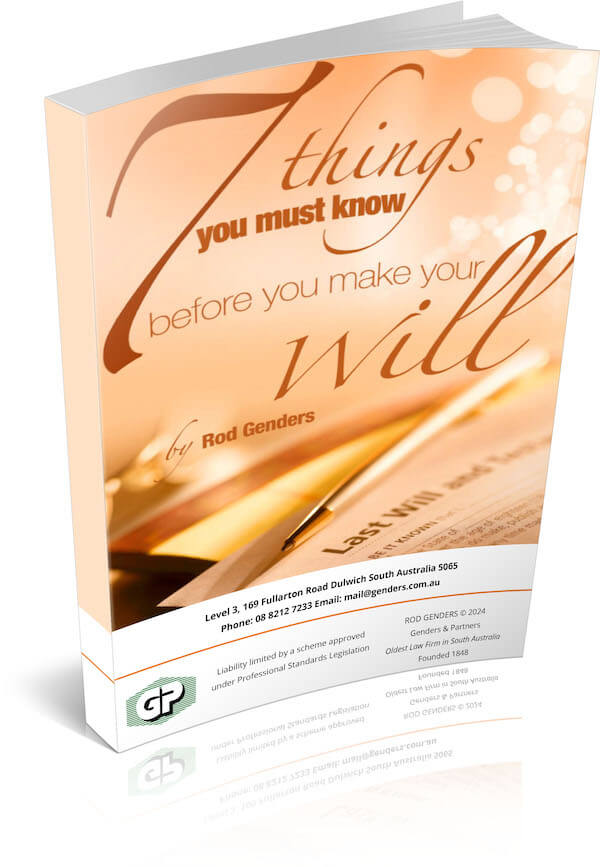
SPECIAL REPORT “7 Things You Must Know Before You Make Your Will”
In this report you will Learn:
Why home-made Wills can be a LOT more expensive than you might think.
The secret weapons used by the rich & powerful to protect their assets, and transfer their wealth two or three generations ahead.
How Estate and Trustee Companies make BIG money from “free” Wills.
The Most Common Estate Planning Mistakes, how they can cost your family a fortune, and How to Avoid Them.
The Elements of a Sound Estate Plan – why a Will alone is not enough.
How to Make Sure Your Assets Stay in Your Family and are not lost to creditors, lawsuits or ex-spouses.
How to guard against challenges to your Estate after you’re gone.